176 keys to a thrilling Boston Symphony premiere
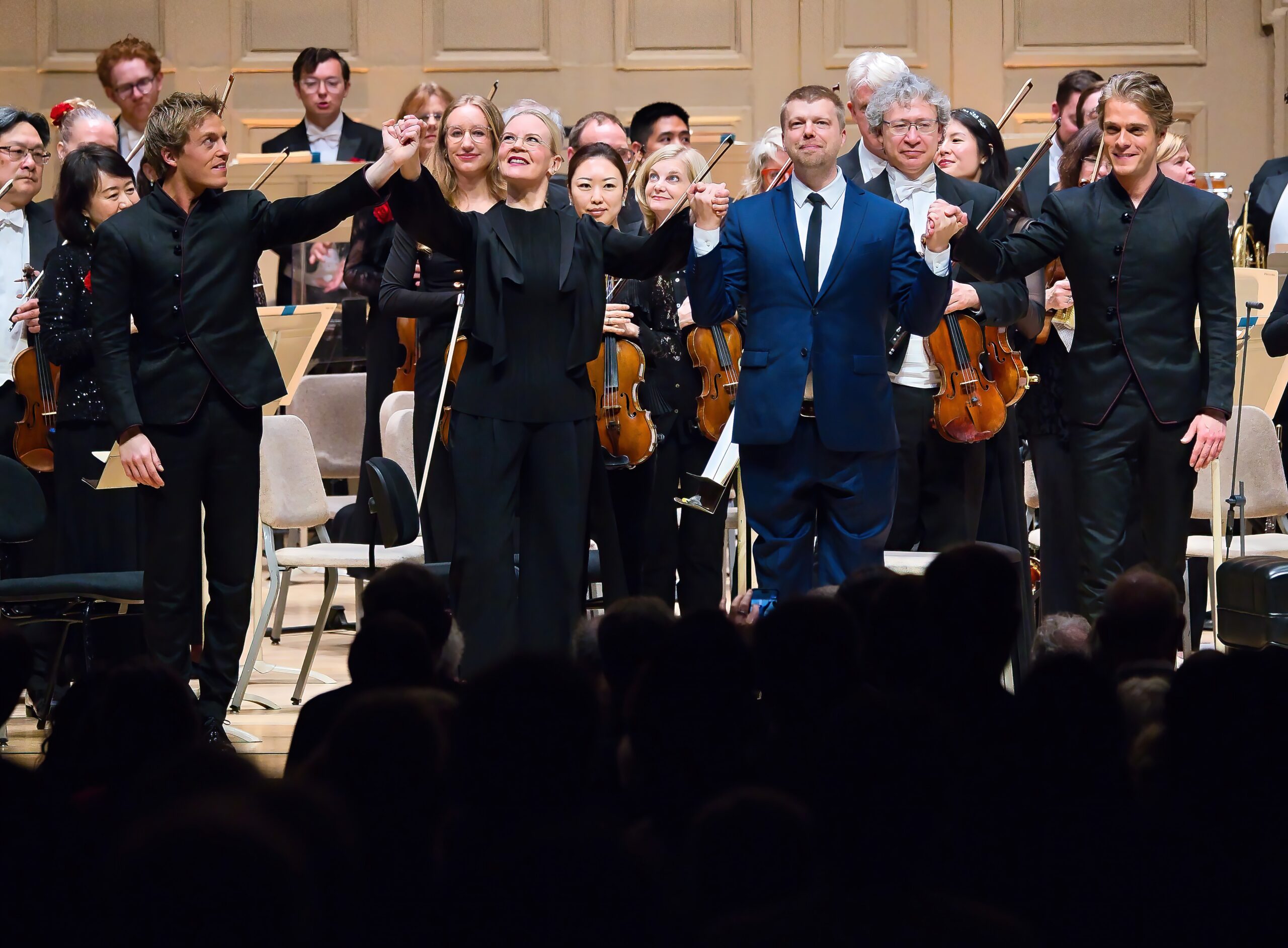
Lucas Jussen, conductor Susanna Mälkki, composer Andrew Norman, and Arthur Jussen acknowledge audience applause following the BSO world premiere of Norman’s Split Thursday night. Photo: Hilary Scott
Music of Ravel and Rachmaninoff made up the lion’s share of the bill Thursday night at Symphony Hall. But the longest and most enthusiastic ovation went to the world premiere of Andrew Norman’s Split, a concerto for two pianos performed by Lucas and Arthur Jussen with Susanna Mälkki conducting the Boston Symphony Orchestra.
Originally crafted as a traditional single-piano concerto for Jeffrey Kahane, who debuted Split with the New York Philharmonic in 2015, Norman has refashioned the work for two pianos, in which form this BSO co-commission was unveiled Thursday night.
Norman says that in its new form Split represents “two protagonists trying to find their way out of a labyrinth of constant distraction.” The composer said the retooled concerto, cast in a single movement of 25 minutes, reflects his feeling about the online world, likening the musical narrative to “a horizonless stream of orchestral channel-surfing or social media doomscrolling.” In his program note and brief stage remarks, Norman adds that over the last decade his feelings about technology and “what it has done to us” have “clarified, evolved and darkened considerably.”
Split begins with a crash from the percussion. After tentative, searching musing on the highest piano keys there is an abrupt leap into a fusillade of driving virtuosity in both pianos—as if reversing traditional concerto structure by opening with the brilliant fireworks of a final movement.
That kind of relentless headlong virtuosity dominates Split, set off by aggressive bursts from Norman’s massive percussion battery, which appears to encourage the soloists’s nonstop flights or attempt to throw them off track. While the effect of the Jussens’ extraordinary musicianship is exhilarating in its sheer speed and bravura, it makes Norman’s point of the addictive nature of online obsessions.
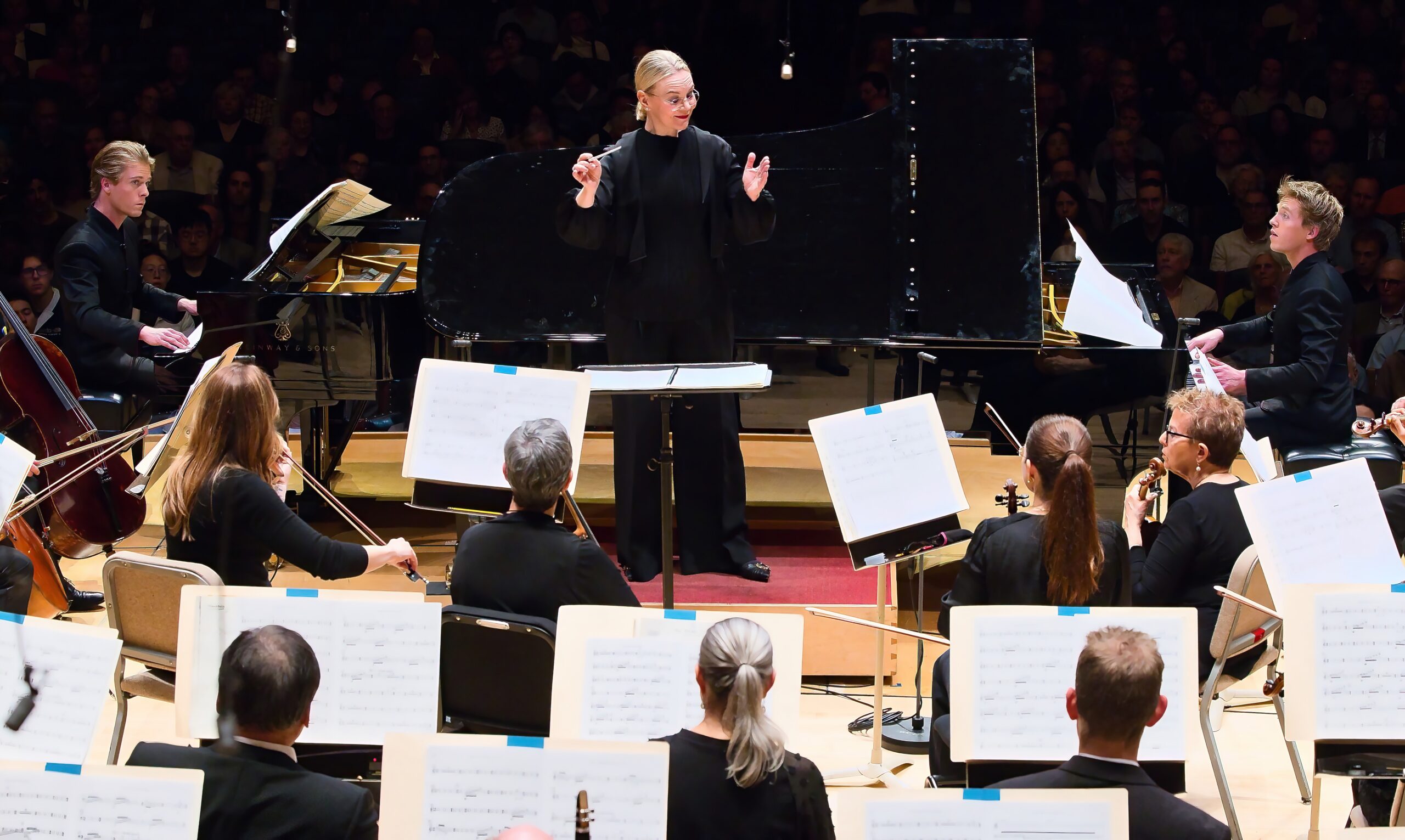
Susanna Mälkki conducted Andrew Norman’s Split with pianists Arthur & Lucas Jussen and the BSO. Photo: Hilary Scot
There are—fortunately, for the soloists—brief respites from the nonstop frenzy of keyboard legerdemain: a playful scherzo-like exchange of notes between the pianos, and a poised lyrical fragment that is echoed by the back benches of the violins. Most striking is a plaintive lyrical theme, nicely layered between the soloists, in which a solo viola briefly joins.
Yet a low growl from the brass sets off another passage of two-piano turbulence with jagged, galumphing orchestral brass accenting the Steinway sturm und drang. Eventually the tempo slows again as isolated notes in the orchestra seem to quell the storm, and a lyrical cascading theme seems to provide some comfort. The high, emphatic piano notes of the opening return and a final percussion slam closes the work.
Split could stand to lose a few minutes in its latter half, which would make things a bit tighter and more effective overall. But Andrew Norman’s well-crafted work is a considerable achievement, a concerto that can be enjoyed on a superficial level for its virtuosic two-piano spills and thrills while the schizoid modulations and abrupt turns make larger points about the internet’s potential for psychic damage.
Lucas and Arthur Jussen gave this premiere a sensational sendoff, serving up all the unbridled and explosive virtuosity the music calls for. Susanna Mälkki is one of our finest conductors of new music and under her taut, spirited and clarifying direction, the BSO musicians provided playing of polished commitment and hair-trigger velocity to match that of the two soloists.
The long and enthusiastic ovation eventually brought the Jussens back out for an encore that offered an oasis after Norman’s hard-charging concerto—a calming, crystalline arrangement (by Greg Anderson and Elizabeth Joy Roe) of the aria “Aus Liebe will mein Heiland sterben” from Bach’s St. Matthew Passion.
It is some indication of Mälkki’s in-demand schedule that this week the Finnish conductor is shuttling between Boston and New York where she is leading performances of Kaija Saariaho’s final opera Innocence at the Met. On Saturday she will conduct the Met matinee before flitting back to Boston for the evening’s performance of the present program.
The concert led off with Ravel’s Ma mère l’Oye (Mother Goose). At times, balances could have been a bit more nuanced with the work at times sounding like a crypto-harp concerto from the center-left side of the house.
But overall Mälkki led a performance that nicely blended clarity and affection, with an expansive rendering of Sleeping Beauty’s Pavane, and a direct and unsentimental rendition of Laideronette that skirted gauzy Chinoiserie. The BSO contrabassoon lent a comically maladroit spirit to the Beast’s lovelorn entreaty to Beauty. And the Fairy Garden finale built to a luminous and resplendent coda aided by Alexander Velinzon’s elegant violin solos. Mälkki took time to recognize several front desk players for their polished contributions.
The conductor’s clear yet animated podium style and supple, communicative baton proved just as effective in Rachmaninoff’s Symphonic Dances, which concluded the evening.
Mälkki drew an idiomatic deep-pile sonority that reflected the Russian as well as American influences in Rachmaninoff’s last major work, the only one written entirely in the U.S. The firm rhythmic impetus of the first movement’s main motif set the tone for a robust yet flexible performance. The nostalgic saxophone solo of the second sounded unsettled Thursday night, possibly due to the loud clatter of a patron’s dropped cane just before his entrance.
The conductor set a measured pace for the strange, spectral waltz at the heart of the middle movement, deftly varying the tempo fluctuations, with the theme haunting in its latter appearance surrounded by wind descants. The finale was most effective, with the BSO musicians in synch with the nervous energy of the music, and Mälkki giving the contrasting lyrical episodes space to register an apt valedictory note of nostalgia. The conclusion proved exhilarating with the frenetic martial music driving to a blistering acceleration at the coda, the conductor allowing the concluding tam-tam note its full implacable resonance.
The program will be repeated 1:30 p.m. Friday and 7:30 p.m. Saturday. bso.org
Posted in Performances
2 Responses to “176 keys to a thrilling Boston Symphony premiere”
Leave a Comment
 Subscribe via RSS.
Posted Apr 18, 2026 at 7:18 am by Paul Greenstone
There is no denying that the Jussens are extraordinary pianists. However, to my ears, Split, which I heard Friday afternoon, is just a piece of disjointed fragments clashing against each other in what was a half hour of endless loud boredom. A construction site’s sounds would have been more interesting.
The Bach encore almost cleaned the palate, but not quite.
Posted Apr 18, 2026 at 1:37 pm by Jennifer Dawson
I thought Split, which I heard Friday afternoon, was fantastic, and the complete opposite of boredom. With its unexpected virtuosic crashes of sound interrupting tentative melodic moments, it felt exactly like the obsessive, ultimately frustrating and upsetting experience of going down the rabbit hole of social media. It was exciting and upsetting in a good way–a reflection of our world today.
The Bach encore was just what was needed to calm the senses.