H&H serves up a vibrant Handel rarity with modern trimmings
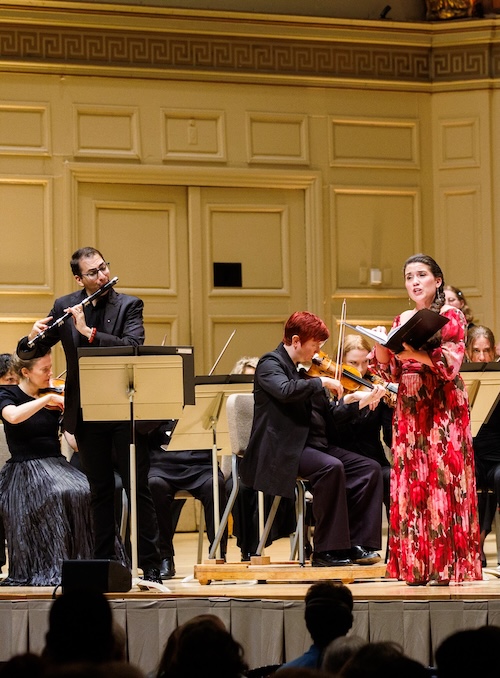
Soprano Joélle Harvey and flutist Joseph Monticello duet in the Handel and Haydn Society’s performance of Handel’s L’Allegro, il Penseroso ed il Moderato. Sunday at Symphony Hall. Photo: Robert Torres
John Milton is having a moment in Boston this fall. Next month, Haydn’s oratorio The Creation, which draws heavily on the poet’s epic, Paradise Lost, makes its way to Symphony Hall.
Meanwhile, this past weekend, the Handel and Haydn Society opened its 212th season with a presentation of its first namesake’s L’Allegro, il Penseroso ed il Moderato. That cumbersome title comes from the fusion of three Milton poems by the librettist Charles Jennens, set to music by Handel in the early weeks of 1740.
Predating Messiah by almost exactly two years, Handel’s pastoral ode for soloists, chorus, and orchestra boasts neither plot nor narrative. Instead, it settles into a series of bardic meditations, some more elliptical than others, on three different types of personality: the extrovert, the introvert, and, bridging the extremes between those two, the temperate.
Jennens, who had worked with Handel on Saul and possibly Israel in Egypt, knew his man: the libretto for L’Allegro is riddled with allusive texts certain to trigger the composer’s enthusiasm for word painting. Handel more than obliged, setting references to warbling birds, winding pathways, chiming bells, and more with an abandon that is sometimes exhausting, never unexpected, and on occasion breathtakingly original.
Though a busy, substantial score, Sunday afternoon’s performance, led by H&H artistic director Jonathan Cohen, never felt unduly heavy nor plodded. Tempos were, on the whole, well-judged, a dancing line threading its way through L’Allegro’s mix of accompagnatos, recitatives, arias, and choruses. While the orchestra periodically covered the three soprano soloists in their lower tessituras, balances were, overall, managed discreetly.
Joélle Harvey delivered her numerous turns with silvery purity, hitting her high notes with conspicuous effortlessness and precision. The American soprano’s dialogues with H&H flutist Joseph Monticello in the aria “Sweet Bird” stood out among the afternoon’s highlights and her melismas in “But oh, sad Virgin” projected with outstanding clarity.
Tenor Paul Appleby brought crisp diction and rhythmic bite to his back-slapping portrayals of outgoing-ness, exuding buckets of brio in his aria, “Haste thee nymph” (with its terrific imitations of laughter), but also warmth in the bucolic duet “As steals the morn.”
Until L’Allegro’s concluding section, Handel seems to have treated the bass as an afterthought, though Sunday’s soloist, Michael Sumuel, brought a terrific mix of power and nuance to each of his appearances. “Mountains on whose barren breasts” was invitingly muscular, while “Populous Cities”—a bustling ode to urban living—conjured visions of Messiah (as well as the thrum of humanity and traffic just outside Symphony Hall’s doors).
The afternoon’s house soloists, sopranos Sonia DuToit Tengblad and Sarah Vitale, both members of the H&H Chorus, were likewise accomplished in their several turns.
That full collective navigated their part in L’Allegro with excellent blend and diction. The presence of the group’s sound emerged with welcome immediacy in moments both reflective (Part 1’s lovely “Join with thee”) and declamatory (the closing choruses for each of the ode’s three parts).
Presiding over it all from the harpsichord, Cohen drew lively and responsive playing from the orchestra. The score’s many fine instrumental touches emerged vigorously—Todd Williams’ brawny horn solos in “Mirth admit me” and cellist Guy Fisher’s florid obbligatos in “But oh, sad Virgin” being among the standouts.
Ian Watson anchored the continuo with typical aplomb. Additionally, he got the carillon to dance in “Or let the merry bells” and ensured that the title instrument made an aptly soaring appearance for “There let the pealing organ.”
The afternoon’s most eye-catching—and potentially controversial—feature was the inclusion of verbal introductions to each of L’Allegro’s sections by spoken word artist Regie Gibson.
On the one hand, such a tack seems entirely superfluous and suggests a lack of trust in Handel’s music, which, despite its age, remains a model of direct expression. At the same time, Jennens’ adaptation of Milton is chock full of Classical references—to Morpheus, Philomel, and Pluto, among others—as well as arcane contemporaneous turns of phrase (“Johnson’s learned sock”) that, likely, are mostly foreign to 21st-century audiences.
In the event, Gibson’s energetic and periodically humorous interjections functioned as a framing device that drew parallels across nearly four-hundred years without veering into preachiness or unaware cliché-mongering. They also didn’t overstay their welcome.
While certainly not necessary for every H&H offering, if the effort opened up new avenues into L’Allegro for part of Sunday’s audience, so much the better.
The Handel & Haydn Society presents Handel’s Messiah at 7:30 p.m. November 27, 3 p.m. November 28, and 3 p.m. November 29 at Symphony Hall. handelandhaydn.org
Posted in Performances
Leave a Comment
 Subscribe via RSS.