Boston Symphony wraps season with heartening Beethoven, uneven Adams
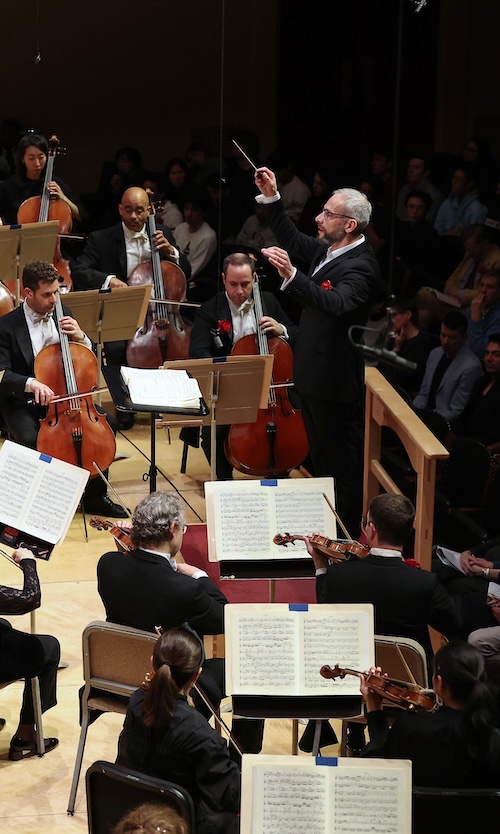
Dima Slobodeniouk conducted the Boston Symphony Orchestra Thursday night at Symphony Hall. Photo: Winslow Townson
Nothing beats a good opening.
As it happened, Thursday’s concert from the Boston Symphony Orchestra boasted two of the canon’s best hooks. The first bars of Beethoven’s Symphony No. 9—quiet, spare, open fifths coalescing into a thundering D-minor triad—are the more familiar of the pair.
But the beginning of John Adams’s Harmonium is just as gripping. There, a lone D morphs, over the course of nearly two minutes, into a diatonic cluster that resolves into a pulsing, vaguely jazzy series of extended chords floating above a rippling orchestral current.
This week’s performance, the first BSO offering of the score since 1991, was part of the final concert program of the orchestra’s 2025-26 season, a year that saw the ensemble belatedly take up several major works by the Worcester-born, Harvard-educated, Berkeley-based dean of American composers.
As with those earlier installments, Thursday’s conductor, Dima Slobodeniouk, is not known as an Adams specialist. Yet many of the qualities that have made him into one of the BSO’s most welcome guest conductors—a propensity for textural clarity, purposeful tempos, a strong grasp of pacing and musical architecture—transfer seamlessly, at least in principle, to this 30-plus-minute-long setting of poems by John Donne and Emily Dickinson.
Adams was just thirty-four when Harmonium premiered in San Francisco in 1981, yet many of the hallmarks of his later operatic and symphonic output can be discerned in its pages. Chief among them is a command of rhythm that is never less than invigorating.
On Thursday, Slobodeniouk was attentive, especially in the early going, to the music’s driving sensibilities. The chugging patterns in the opening setting of Donne’s “Negative Love” boasted both lightness and direction. The orchestral contributions there were correspondingly bright and energetic. So, too, the first half of the concluding “Wild Nights,” though the transition into that section was a shade frantic.
Unfortunately, the Tanglewood Festival Chorus, prepared this week by Jean-Sébastian Vallée, was not up to Harmonium’s demands, at least in its outer thirds. Their singing in those parts was generally tentative and underpowered. Though nothing about Adams’s writing in this score is simple, it shouldn’t feel so treacherous as the TFC made it sound on Thursday.
True, the music’s large, collective declamations usually came out well. The first movement’s “I never stooped so low” statement was enunciated with admirable clarity and the finale’s last melisma floated beautifully.
But “Negative Love’s” magical opening was a muddle and its volleying “If that be simply perfectest” figures never locked in. Neither did the finale’s “Futile—the winds—/To a Heart in port—” or the “Rowing in Eden” canons; the last were virtually inaudible. Partly because of that, the poignant, concluding “Ah—the Sea!” episode lacked a necessary degree of revelation and release.
Only in the central “Because I could not stop for Death—” did the chorus sound not just at ease but truly comfortable, shaping Adams’s touchingly simple melodic lines with warmth and confidence. Slobodeniouk and the BSO offered playing here of hypnotic delicacy, shape, and detail: the quiet clanking of cowbells near the end was one of the night’s most affecting moments.
The Beethoven Ninth Symphony that followed intermission seemed intent to compensate for the Harmonium performance’s shortcomings. To be sure, Slobodeniouk’s approach to Beethoven’s 1824 icon is unsentimental. Yet it’s hardly cold. Thursday’s rendition was well-balanced and -directed, rhythmically pointed, and closely attentive to matters of dynamic nuance.
That approach highlighted the sheer novelty and visionary nature of Beethoven’s writing in the instrumental sections. One could hear, for instance, foreshadowings of Berlioz (and Webern, for that matter) in the first movement’s plays of color, as well as the Scherzo’s diabolically hammering climaxes.
The harp imitations in the Adagio—perhaps derived from similar gestures in the Op. 74 string quartet—also came out bewitchingly. For its part, the finale’s setting of Schiller’s Ode “An die Freude” sounded irrepressibly joyful, its orchestral introduction radiant and energetic.
Granted, here Slobodeniouk’s interpretation might have occasionally benefited by taking a longer view: the fugue and big statement of the famous melody were a shade aggressive and the closing pages frenetic. Yet there were lovely subtleties to be found, too, like the blend of low strings and woodwinds in the “Ihr stürtzt nieder’s” accompaniment.
Throughout, the TFC was in top form, singing with robust purpose and tonal blend, especially during the symphony’s climactic spots. The sopranos held their own in Beethoven’s exposed, high-tessitura writing. So did the night’s stable of soloists—soprano Andrea Carroll, mezzo-soprano Zoie Reams, tenor Andrew Haji, and bass Morris Robinson—who navigated their parts with resonance and power, if not always intelligible diction.
Ultimately, the music’s vision of brotherhood and good will came across. Given the tumult at Symphony Hall these last few weeks (the floor and stage were, once again, a sea of red carnations), one couldn’t help but wonder if the music’s paean to good will had a special, in-house focus this time around. It certainly worked its magic on the night’s audience, which responded with an instant ovation that included hearty cheers for the season’s lone retiree, assistant principal oboe Keisuke Wakao.
The program will be repeated 1:30 p.m. Friday, 8 p.m. Saturday, and 2 p.m. Sunday at Symphony Hall. bso.org
Posted in Performances
Leave a Comment
 Subscribe via RSS.