Viano Quartet displays mesmerizing artistry for the Celebrity Series
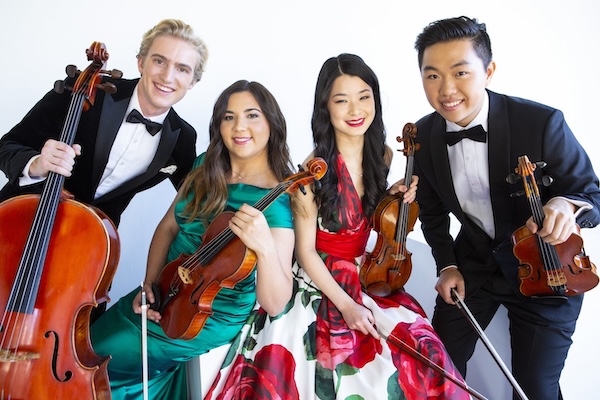
The Viano Quartet performed Sunday afternoon at Groton Hill Music Center. Photo: Jeff Fasano
What’s the deal with Dmitri Shostakovich and E-flat major? Traditionally, that key is employed to represent grandeur, nobility, heroism—think Beethoven’s Symphony No. 3 or Strauss’s Ein Heldenleben.
Yet, in his use of that tonal area, Shostakovich was consistently happy to flip the anticipated script. Yes, his Cello Concerto No. 1 generally does what one expects. But the Third and Ninth Symphonies don’t. Neither does the String Quartet No. 9.
Completed in 1964, that five-movement effort is a model of tenacity and perseverance. Also, virtuosity and compositional rigor. But the music’s heroic cast—if that’s what it is—is painfully, even angrily earned. Its nobility is won, not inherited; its grandeur scarred, battle-tested.
Or so it sounded on Sunday afternoon, when the Viano Quartet assayed the score as part of their Celebrity Series debut at Groton Hill Music’s Meadow Hall. Winners of this year’s prestigious Avery Fisher Career Grant, the Vianos are an electrifying collective.
To say they play well together is to state the obvious. What makes them captivating is subtler, harder to pin down. They check all the requisite technical boxes: practically perfect intonation, responsive phrasings, unified articulations, carefully calibrated dynamics.
But the tetrad—violinists Lucy Wang and Hao Zhou, violist Aiden Kane, and cellist Tate Zawadiuk—also understands how to translate technique into expression. There’s an aura of rightness and purpose to their playing, of four individuals functioning as a single instrument, that, as somebody put it during intermission, is breathtaking. At the very least, their musicianship served the afternoon’s meaty program of music by Haydn, Mendelssohn, Webern, and Shostakovich exceedingly well.
Not that any of Haydn’s string quartets require much interpretive assistance: when done right, these works all but play themselves. Still, it was invigorating to hear the Viano’s tonally fresh, rhythmically exact account of the Viennese master’s D-major String Quartet Op. 76, no. 5.
The music’s contrasts and dialogues were all strongly etched, textures outstandingly clear. Inward episodes in the middle movements—the soft exchanges between viola and cello beneath pulsing violins in the Largo and the Minuet’s minore Trio, in particular—spoke with bewitching intensity. The exuberant finale was a definition of wit and personality, violinist Wang dispatching the high-flying first violin runs with aplomb.
She swapped chairs with Zhou for Mendelssohn’s String Quartet No. 3 and the change in leadership immediately told. Sunday’s wasn’t exactly a demure account of this D-major effort—the music is too extroverted to allow for such an outcome—but it felt somewhat constrained. Certainly, it stands to reason, the soloistic first desk part won’t get hurt if it’s pushed a bit more aggressively.
Nevertheless, Zhou had all his notes squarely in hand and he led his colleagues in notably songful renditions of the Quartet’s densely active outer movements. For all the performance’s snapping rhythms and dazzling contrapuntal displays, however, its beating heart emerged in the Andante. Here, the discreet interplay of lines—sometimes coalescing, sometimes going their own ways—offered the concert’s finest illustration of the Viano’s artistry, equal parts independence and unity, tied together by a common purpose.
Those qualities also emerged in the group’s reading of Anton Webern’s Langsamer Satz. Lush, autumnal, and slightly discursive, this is unabashedly lovely music and the Vianos delivered it with just the right degree of urgency and direction.
They brought those same attributes to Shostakovich’s Ninth Quartet. Though its opening materials—drones and an unpromising noodling figure—don’t suggest it, this is mightily involved music that, like Haydn, doesn’t require heavy-handed intervention. Accordingly, the afternoon’s interpretation mainly let the notes speak for themselves.
The results were sometimes harrowing: the central Allegretto transformed from weirdly cute to nightmarish in a matter of seconds (the changing colors of the setting sun through the windows behind the stage helped to underline the effect). Crunching dissonances spoke pointedly, as did the explosive pizzicato attacks passed around the quartet in the last two movements.
At the same time, Zhou and violist Kane brought soulful passion to the first Adagio’s refrains. The fourth movement’s chorale-like statements were touchingly devotional. And the involved finale came across as a wild, sardonic ride, its transitions bristling and the culminating statements of its hammering main motto singing defiantly.
If not heroic in the conventional sense, then, Sunday’s traversal was decisively triumphant, as much for the Vianos as for Shostakovich, whose ability to spin straw into gold remains astonishing a half century after his death. Likewise impressive was the group’s encore, an arrangement of Debussy’s Claire de lune in which tonal beauty and textural delicacy wove an enchanting, glassy web that seemed to hover in the night sky.
The Celebrity Series presents pianist Beatrice Rana playing music by Prokofiev, Debussy, and Tchaikovsky 8 p.m. November 8 at Jordan Hall. celebrityseries.org
Posted in Performances
One Response to “Viano Quartet displays mesmerizing artistry for the Celebrity Series”
Leave a Comment
 Subscribe via RSS.
Posted Nov 03, 2025 at 3:01 pm by Mitch
They were absolutely mesmerizing!