Lisiecki provides the highlights in a BSO night of literal music-making
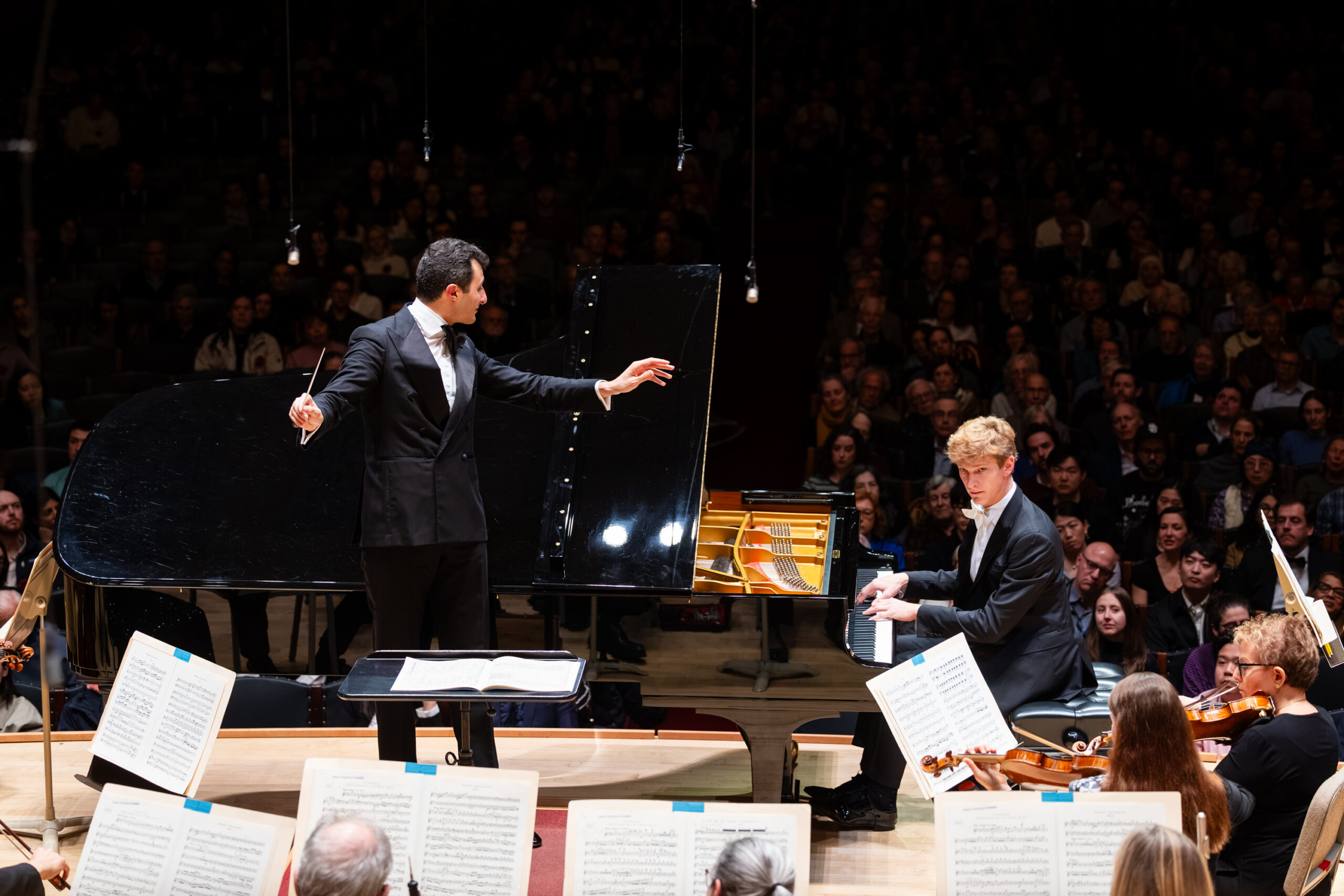
Jan Lisiecki performed Mendelssohn’s Piano Concerto No. 1 with Samy Rachid and the BSO Thursday night. Photo: Robert Torres
Arthur Rubinstein knew what he was talking about: in order to fully understand Robert Schumann’s music, one needs to live like him. “Don’t forget,” the venerable keyboardist once told a young Michael Tilson Thomas, “to save plenty of time to travel, see great art in museums, eat, drink great wine, eat wonderful food, meet fascinating people.”
Samy Rachid, who led the Boston Symphony Orchestra in that composer’s Symphony No. 1 on Thursday night, might do well to take the older artist’s advice more to heart.
Not that the ensemble’s assistant conductor missed out on the score’s youthful energy and rhythmic verve: both were amply evident in the evening’s traversal. But his interpretation was one that seemed content to underline the occurrence of big musical events—The first movement development! The Scherzo’s second trio! The finale’s coda!—at the expense of nuance, subtlety, and poetry.
And a Schumann symphony without poetry is rather like a bowl of ice cream that’s been sitting out on the counter for an hour: still potentially tasty, but a bit of a mess.
Thus went the night’s outing. The score’s framing movements were lively enough, but fast stretches often felt breathless and, in the finale, Rachid’s opening tempo didn’t leave enough room for the coda’s accelerando to really go anywhere. Refrains in the Scherzo, too, lacked a certain measure of focus and definition.
The Larghetto offered something of a reprieve, with delicate woodwind solos and, at the end, a haunting trombone chorale. In the last movement, too, Elizabeth Klein made beautiful work of the flute cadenza.
But the larger undertaking was literal and lacked insight. That it was accompanied by a patron in the first balcony periodically clapping along to the music and offering verbal interjections to the proceedings seemed strangely fitting.
A similar insistence also marked the night’s opener, Carl Maria von Weber’s Overture to Oberon. Slow tempos were broad, fast ones frantic. Balances in big moments were regularly problematic, too: for all the evident fury of the violins’ “con fuoco” passagework, precious little heat emerged, buried, as it was under a blanket of accompanimental woodwind, brass, and timpani sonorities.
Some sparks did fly more or less as expected in Mendelssohn’s Piano Concerto No. 1, which came between those items. Though often compared with Mozart, the Hamburg native’s music sometimes benefits from being treated more like Beethoven’s (so, for that matter, does much of Mozart’s output).
On Thursday, Jan Lisiecki appeared happy to oblige, bringing a shapely intensity to his account of the solo line. If the outer movements were a bit blurry on account of the pianist’s speed, they were consistently attuned to matters of dynamics and phrasing. Lyrical episodes, too, were enchanting and the finale’s elfin turns models of character.
Though there were some inspired moments in the orchestra’s accompaniment—the Andante’s coda was particularly delicate—a sense of ensemble and soloist playing past each other pervaded the reading.
Some of this was a matter of balances which, in outer sections, weren’t as discreet as they might have been. The slow movement’s opening string phrase, too, was several notches above the indicated piano. At the same time, there was an aggression to the performance that, while not entirely unwelcome, resulted in an uncomfortable edge to certain articulations and attacks in the outer movements.
Lisiecki’s encore of Brahms’s Waltz in A-flat (Op. 39, no. 15), however, provided a welcome antidote to the memory of those: three minutes of unvarnished radiance for a night otherwise fitfully in search of the sublime.
The program will be repeated 1:30 p.m. Friday and 8 p.m. Saturday at Symphony Hall. bso.org
Posted in Performances
Leave a Comment

 Subscribe via RSS.