A rousing Russian program opens final season for Boston Phil Youth Orchestra
The beginning of the end has come for the Boston Philharmonic Youth Orchestra. The Boston Philharmonic announced in March that both the orchestra and the youth ensemble will close after this season.
Founded by conductor Benjamin Zander in 2012, the young musicians opened their final season at Symphony Hall Friday night with a fanfare of works by three generations of Russian composers: Glinka, Stravinsky, and Tchaikovsky.
If an orchestra is judged by how it ends, Friday night’s performance proved the youth orchestra as an artistic triumph on par with even the most professional orchestras.
Zander barely reached the podium before barreling into Glinka’s Ruslan and Ludmila Overture. The five-minute piece is a sprint of fanfare, color, and racing lines. Some coordination slipped in the strings as they switched between pizzicato and arco, but the finale landed with convincing force.
After a long-winded explanation of the ballet’s narrative, Stravinsky’s 1947 version of Petrushka followed. Zander conducted the work seated so as, he said, to not to distract the audience from the music.
It was a generous idea. But the redundant accompaniment of supertitles that quasi-narrated the scenario became a distraction of its own, essentially repeating the mini-lecture before the piece began. The fine playing of the musicians needed no help.
The opening “Shrovetide Fair” was fantastical, full of orchestral color and athletic playing. In “Petrushka’s Cell,” pianist Yiran Zhou poured the imprisoned puppet’s frustration and heartbreak into playing of mystery and restless energy.
The orchestra played with caution thrown to the wind, and in Stravinsky that is a virtue. In “The Moor’s Alcove,” the Ballerina’s waltz was so vividly characterized one needed only to close one’s eyes to see dancers.
The final movement belonged to the harps and winds. Harpists Sofia Graupera and Leila Hudson filled the hall with fantasy while the wind section’s trills shimmered as they kept up the fair’s restless bustle beneath a smooth surface.
After intermission, Zander spoke again, more briefly, and stood to conduct Tchaikovsky’s Symphony No. 5.
Tchaikovsky wrote the symphony in the summer of 1888, a decade after his Fourth, when the composer was full of doubt. Today, his Fifth is one of the most beloved symphonies in the repertoire.
The first movement delivered a welcome change of atmosphere after the first half’s repeated fanfares. The clarinet and bassoon extracted heartfelt melancholy from the main theme, and the full orchestra drove the secondary theme to an existential forte with real weight.
The Andante cantabile was the high point of the entire evening both in its execution and music. The low strings opened with carefully weighted chords, and Mauricio Martinez floated the famous horn solo with a calm and eloquent expression.
The Valse that followed was a charming interlude. In the Finale, the Fate theme introduced in the first movement returns in a major key, and Zander let loose all the power the orchestra had in reserve, closing in a blaze of glory, and bringing the orchestra full circle from the Glinka Overture that opened the concert.
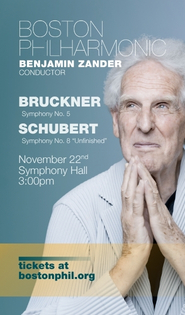
The Boston Philharmonic Youth Orchestra performs Ravel, Rachmaninoff, and Shostakovich with pianist George Li at 8 p.m. Feb. 26 at Symphony Hall. bostonphil.org
Posted in Performances
Leave a Comment


 Subscribe via RSS.