Zander opens Boston Philharmonic’s final season with lucid and tragic Brahms
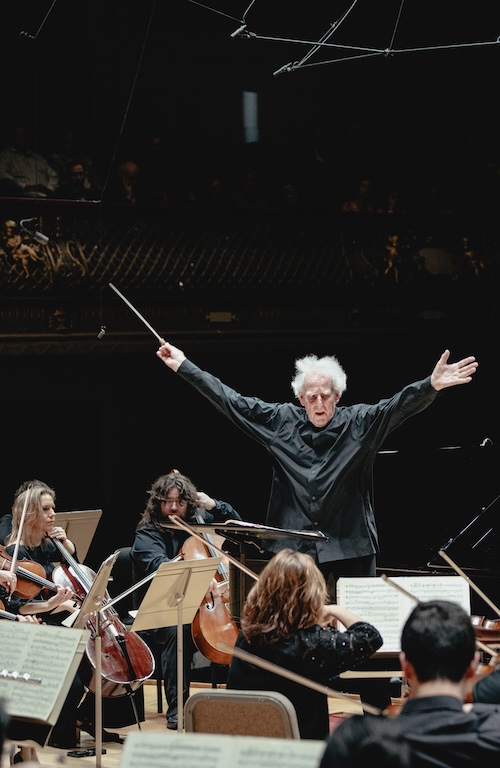
Benjamin Zander conducted the Boston Philharmonic Orchestra in music of Brahms and Beethoven Sunday at Symphony Hall. File photo: Paul Mardy
By returning to the source, Lao Tzu tells us, one finds serenity.
That seems to be a guiding principle for the Boston Philharmonic Orchestra in this, the ensemble’s final season. Not that the group has ever wandered too far from the core of the orchestral repertoire: its bread-and-butter has always been the 19th– and early-20th-century German Romantic canon.
Even so, long experience with what founding conductor and music director Benjamin Zander describes as “desert island” works can pay dividends. “You take [this music] on the desert island because you need all that time to study it,” he says. “You’ll never get to the bottom of it.”
Sunday afternoon’s concert at Symphony Hall bore out the sentiment, especially with its closing item, Brahms’s Symphony No. 4.
This is, on the one hand, deeply familiar music: Herbert Blomstedt led it with the Boston Symphony just last March and Zander has conducted it at least eight times with the BPO, most recently in 2021. Yet frequent performances have hardly exhausted the score’s expressive depths.
This weekend’s interpretation was, in the outer movements especially, decidedly tragic: the finale’s waltz into the abyss packed implacable forward momentum and a terrific sonic presence. In the somewhat less grim opening movement, the BPO ratcheted up the musical tension by paying close heed to the music’s duple-against-triplet rhythms.
Though Brahms is occasionally criticized for thick orchestrations, there was nothing unduly dense about this performance. Instead, Sunday’s was a notably lucid and well-directed account—warm, sonorous, and flexibly phrased.
The last was particularly true of the Andante, which sang with touching beauty and a wonderful sense of shape, both structural and dynamic. For the Allegro giocoso, as well, Zander and the orchestra brought just the right touch, illuminating the section’s hurly-burly with Oktoberfest-worthy panache.
Beethoven’s Violin Concerto, which preceded the Brahms, doesn’t boast the latter, although its finale does offer more than a small share of rustic exuberance. Instead, the score delivers a masterclass in elevating the most elemental materials—in this case, primarily scales and arpeggios—into something far beyond the sum of their parts.
Zander has long been a Beethoven specialist and his early insistence on adhering to the composer’s controversial metronome markings was some twenty years ahead of its time. Expectedly, this final take on the concerto knew where it was going and that it shouldn’t dawdle.
But the point of livelier tempos in this music has never been an end in itself; rather, the approach has always been geared towards more important goals. What emerged on Sunday was a sense of architectural rightness and proportion to this sprawling, forty-plus-minute-long score that felt eminently proper. Also, textural clarity—though that had as much to do with the BPO’s excellent attention to dynamics as anything else.
The last ensured that the afternoon’s soloist, Guy Braunstein, was never covered.
A former concertmaster of the Berlin Philharmonic, Braunstein has become a regular, favorite guest of the Boston Philharmonic these last few years. He knows his way around this concerto, though his tone and articulation Sunday bordered on acerbic and scrappy, which tended to underline the technical rigor of the solo line.
But Braunstein’s approach was clearly a choice, and the music could certainly handle it. If the finale was perhaps more brawny than beautiful as a result—the downbeats heavily emphasized, passagework dry—the concerto’s recurring first-movement runs were appealingly rhapsodic and the Larghetto’s mesospheric arpeggios unfailingly pure. A knuckle-busting encore of Brahms’s Hungarian Dance No. 6 brought down the house.
To lead off the afternoon, Zander and the Philharmonic offered a characterful traversal of Weber’s Overture to Der Freischütz. While the introduction was a shade reflective, the score’s turbulent main body and blazing coda captured much of what Berlioz once described as the composer’s “wild and captivating fragrance.”
The Boston Philharmonic Orchestra plays Schubert’s “Unfinished” Symphony and Bruckner’s Symphony No. 5, 3 p.m. November 22 at Symphony Hall. bostonphil.org
Posted in Performances
Leave a Comment

 Subscribe via RSS.