Lewis and Mhoon bring wide range and nuance to thoughtful Vivo program
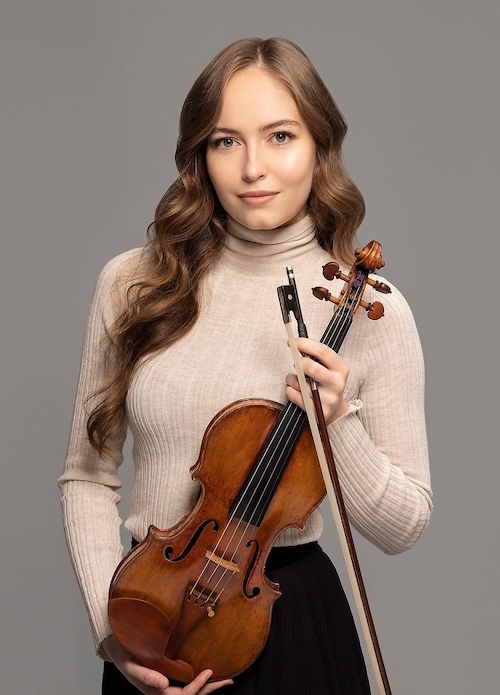
Geneva Lewis performed a recital with pianist Joshua Mhoon for Vivo Performing Arts Sunday afternoon. Photo: Matthew Holler
Leopold Mozart had thoughts about violinists and bowing. In his 1756 treatise on playing the instrument, he ascribed to the latter technique nothing less than the responsibility for “rous[ing] in hearers the…affects”—in other words, conveying the expressive essence of the music.
To judge from her recital at Groton Hill Music’s Meadow Hall on Sunday afternoon, Geneva Lewis has taken the 18th-century pedagogue to heart in this matter. Her performance, which marked the Vivo Performing Arts debuts of both the award-winning violinist and her accompanist, Joshua Mhoon, was often enough a masterclass in bow control.
Partly as a result, their program, which ran, chronologically, from the G-major Violin Sonata by Leopold’s son Wolfgang to Valentin Silvestrov’s Two Pieces, was outstandingly well-directed and multi-dimensional. At the same time, the lineup offered some intriguing threads across its two halves.
Silvestrov and Anton Webern, for instance, functioned as adepts of very different kinds of aphorism.
The latter’s Four Pieces channel abstraction to the highest degree. In them, gestures—be they explosive, skittish, or virtually static—are elevated to the same level as pitch and harmony. Silvestrov’s opus, on the other hand, traffics in the pure simplicity of delicate melodic lines that suddenly, unexpectedly come apart, like sweater threads accidentally caught on a nail.
Yet, heard in Sunday’s context, each work achieved surprisingly similar affective results.
The Webern allowed Lewis and Mhoon to showcase their considerable dynamic range—the third movement was ethereal and ghostly—and, especially in the slashing “Rasch” section, pinpoint ensemble.
Meantime, the pair brought sincerity and warmth to Silvestrov’s diptych. There, the music’s unexpected forays into dissonance and textural opacity emerged hauntingly, especially during the concluding “Barcarola.”
The Ukrainian composer’s Pieces tracked as a logical answer to Mozart’s 1781 sonata (K. 379), which opened the afternoon. An impressively weighty installment from the then-25-year-old composer, its two-movements follow a peculiar structural logic: the first half consists of an expansive Adagio that leads into an abbreviated sonata-form Allegro while its second involves an elaborate set of variations on a deceptively simple tune.
On Sunday, Lewis’s clean projections—her opening figure was beautifully present and shaped—formed a lovely counterpoint to Mhoon’s occasionally thick-textured pianism. Though maintaining a certain tonal and artistic independence from one another, the pair brought out the first movement’s sturm und drang with purposeful zest and also captured much of the subtle, ambiguous magic of the variations, especially its luminous Adagio.
Contrasts of lyricism and tone also mark Mieczysław Weinberg’s Violin Sonata No. 5, though its perspective seems at least partly shaped by the composer’s 1953 imprisonment on charges of “Jewish bourgeois nationalism.” By turns sober, stormy, and ironic, the score shares a certain accent with music by the composer’s friend, Dmitri Shostakovich—not to mention a similar search for serenity in the face of trauma.
Yet it’s hardly derivative stuff. Sunday’s account was smartly shaped, especially in the opening movements, Lewis applying the tonal purity she’d brought to the Mozart to far more harrowing ends here.
The screaming double-stops in the Andante were as gripping for intensity as were the third movement’s skeletal dancing phrases. In that section, too, Lewis and Mhoon evinced an invigorating command of dynamic shape. Though the finale’s climax felt a touch mismatched—the pianist navigated his symphonic-sounding part with an impressive mix of deftness and muscularity, but the violin line was underpowered at this moment—its quiet, burbling episodes came out with enchanting precision.
If Weinberg’s score mines the darker extremes of musical expression, Richard Strauss’s Violin Sonata in E-flat seeks out the opposite. Virgil Thomson once labeled this 1887 composition “bombastic” and “second-rate”; perhaps he was being generous with the latter charge.
Certainly, the sonata demonstrates the then-23-year-old composer’s facility writing for both instruments. But, a couple of characteristic moments notwithstanding, the outer movements are thematically dry, and its central “Improvisation” hardly offers the probity of Strauss at his lyrical best.
Even so, the strongest moments of Sunday’s account emerged in that second section, whose impassioned middle part was bookended by songful playing of becoming focus and inwardness from Lewis’ and Mhoon’s impressively simpatico partnership.
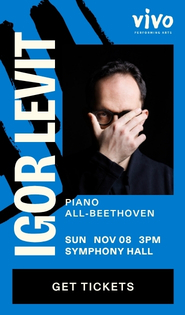
Vivo Performing Arts presents Igor Levit playing music by Beethoven 3 p.m. November 8 at Symphony Hall. vivoperformingarts.org
Posted in Performances
Leave a Comment
 Subscribe via RSS.