BSO’s Rachmaninoff night finds its thrilling, virtuosic groove with Nelsons and Cho
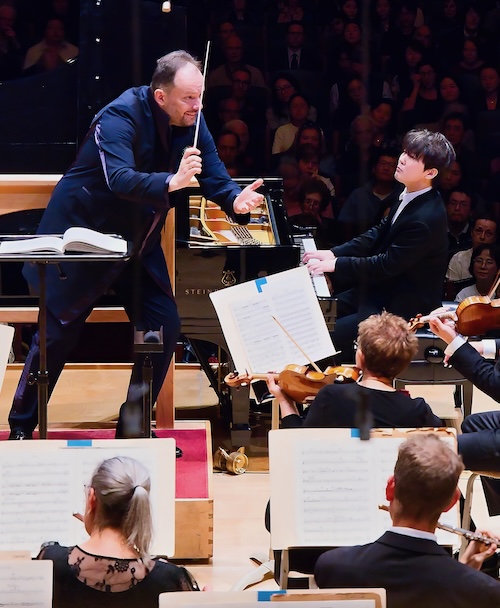
Seong-Jin Cho performed Rachmaninoff’s Rhapsody on a Theme of Paganini with Andris Nelsons and the Boston Symphony Orchestra Wednesday night. Photo: Hilary Scott
Though his American career is most closely associated with the Philadelphia Orchestra, Sergei Rachmaninoff was no stranger to Boston. Between 1909 and 1937, the Russian-born composer-pianist appeared in concert with the Boston Symphony Orchestra more than twenty times. On the final occasion—concerts on Christmas Eve and Day, no less—he presented the local premiere of his Rhapsody on a Theme of Paganini.
On Wednesday night, that beloved chestnut made its return to Symphony Hall, this time with Seong-Jin Cho at the keyboard and Andris Nelsons on the podium.
There is no denying the craft and brilliance of Rachmaninoff’s writing in the Rhapsody. Though his music can brood with the best, there’s a sense of playfulness and glee that marks many of this score’s passages; it’s no backhanded compliment to label the work a showpiece of the highest order.
The 32-year-old Cho, whose recent local performances have shown him to be one of the compelling keyboardists of a stocked generation, took to the Rhapsody’s athleticism on Wednesday with abandon. His reading brought vigor and volume to the music’s big exclamations: at times he seemed to be channeling Yefim Bronfman for muscularity.
But his playing was also agile and fleet. No devilish hand crossings or knotty textures failed to speak characterfully. What’s more, the inward episodes over the score’s middle part were unfailingly well-voiced and -directed. The famous 18th variation emerged as something natural and beautiful, eschewing, from soloist and orchestra, any hint of bathos or sentimentality.
The BSO took a little while to settle into its groove: the Rhapsody’s opening third or so felt less like a simpatico collaboration than a blind date getting off to a tentative start. But once the connection was made—by the 12th-variation minuet, dialogues between pianist and orchestra were fully on-point—the performance took on a life of its own. The drive to the end was particularly spirited and exciting.
After the fireworks, Cho offered an encore of subdued beauty: Chopin’s Waltz No. 19 in A minor.
Restraint isn’t an adjective often used to describe Rachmaninoff’s Symphony No. 2, which followed intermission. Dense, expansive, filled with unfailingly attractive melodic writing and no shortage of brilliant instrumental touches, the score, which clocks in around the 60-minute mark uncut (as it was presented Wednesday), can also sound—or feel—overlong.
So it did at times on this outing, at least in the opening pair of movements. In the first, Nelsons capably outlined the music’s dynamic shape and generally kept tempos moving. Climaxes, though, tended towards textural opacity and the through-line holding together the sprawling structure sometimes got lost in the resulting soup.
The Allegro molto, too, eventually found a solid footing—the fugue was biting and crisp—but the iterations of its opening refrain seemed to take a few repetitions to settle into a comfortable tempo (the score indicates all of these statements should be played at the same speed).
Nevertheless, Nelsons and the orchestra delivered an account of the great Adagio that was outstanding for its warmth, color, direction, and clarity. The fadeout at the end was a masterpiece of concentration and control that was, unfortunately, marred on this occasion by a smattering of applause.
The finale was burly and urgent. If, again, the BSO’s sonic profile was a touch monochrome, the orchestra evinced a riveting dynamic range and the movement’s closing bars proved thrilling and cathartic.
The program will be repeated 7:30 p.m. Thursday, 1:30 p.m. Friday, and 8 p.m. Saturday at Symphony Hall. bso.org
Posted in Performances
One Response to “BSO’s Rachmaninoff night finds its thrilling, virtuosic groove with Nelsons and Cho”
Leave a Comment
 Subscribe via RSS.
Posted Oct 13, 2026 at 6:51 am by Lucy Li
I attended the Boston Symphony Orchestra concert on October 1, featuring Seong-Jin Cho performing Rachmaninoff’s Rhapsody on a Theme of Paganini with Andris Nelsons conducting. My seat was on the left side of Section F, with a particularly clear view of the cello section.
Seong-Jin Cho was magnificent. He captured both the beauty and drama of Rachmaninoff’s beloved work with remarkable sensitivity and intensity. The music seemed to move through his entire body. At climactic moments, he would rise slightly above the bench, his arms flowing naturally with the phrases. Yet nothing felt exaggerated or theatrical. Every gesture appeared to grow organically from the music itself.
Because of my location, however, Cho was not always in my direct line of sight. Unexpectedly, my attention was drawn to the cello section, and especially to principal cellist Oliver Aldort and his colleague beside him. Watching them play became one of the highlights of the evening. Their body movements, facial expressions, and complete immersion in the music brought another dimension to the performance. I could not only hear their contribution but also see how deeply they were engaged with every phrase.
In a sense, they stole the show for me. Their playing captured both my eyes and my heart. By the end of the performance, I found myself applauding not only the soloist and conductor, but also the cellists whose artistry had enriched my experience so profoundly.
There was a moment during the acknowledgments when Andris Nelsons warmly took the hands of both the concertmaster and Aldort together, giving them shared recognition. I found that gesture moving and fitting, a reminder of the collaborative spirit that makes orchestral music so special.
This concert also changed the way I think about seating at Symphony Hall. The cello section made such a strong impression on me that I now want to sit as close to them as possible at future BSO performances. Their musicianship added immeasurably to my enjoyment of the evening and reminded me that some of the most memorable moments in a concert come not only from the featured soloist, but from the extraordinary artists who bring the orchestra to life.
To the BSO cellists: thank you. You made a difference, and you made this listener want to return to hear and watch you again.