BSO’s intriguing if unwieldy Machover premiere provides musical and AI food for thought
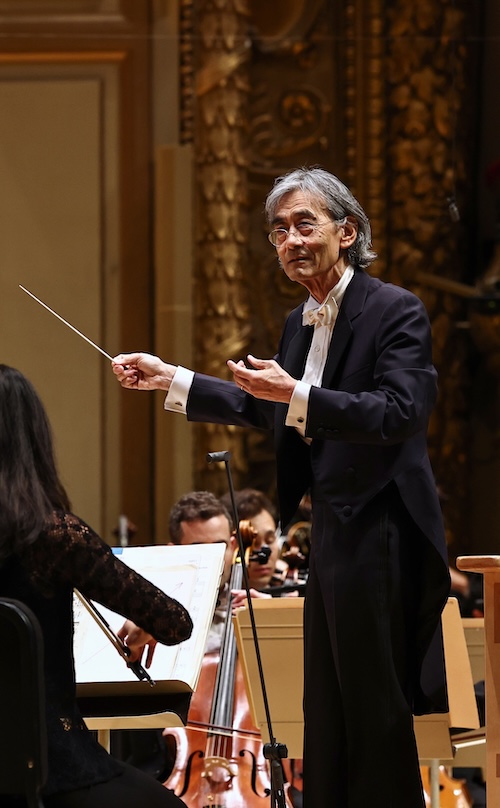
Kent Nagano conducted the Boston Symphony Orchestra in the world premiere of Tod Machover’s already and not yet Thursday night at Symphony Hall. Photo: Winslow Townson
Who’s afraid of AI? Not Tod Machover, the visionary MIT-based composer, much of whose career has been spent navigating the relationship between live performance and technology.
For the centerpiece of Thursday night’s concert at Symphony Hall, the Boston Symphony Orchestra commissioned the New York native’s already and not yet, a thirty-minute fusion of orchestra and electronics that involves sound processing via artificial intelligence. Part of the BSO’s weeklong “Technology & Our Humanity” initiative, Machover’s opus—which gets its title from a line in a David French essay—may court some controversy through its use of machine technology.
But, in practice, the composer’s employment of AI in already and not yet is just the next logical step in the decades-long story of electroacoustic music: the AI system, which was developed in collaboration with MIT graduate student Manaswi Mishra, doesn’t sample existing music or generate any on its own. Instead, it responds to the orchestra’s performance in real-time. The handful of pre-recorded sounds it employs were taped specifically for this work.
Fittingly, given the score’s use of cutting-edge technology, the overarching concept at play in already and not yet is thoroughly du jour: nothing less than “the state of the world and of our country.” Its three sections—SMASH UP, WAKE UP, and STAND UP—propose to chart a course from violence and conflict to awareness and positive action, with technology functioning as a partner and illuminator in the process.
Thursday’s world premiere, led by Kent Nagano, captured the explosive nature of the first movement impressively, as well as the second’s progression into mindfulness. Yet the larger musical argument occasionally sounded tentative and didn’t always cohere; the question of whether or not the score’s content and aims align remains open.
Granted, this is complex music. Machover, in his introductory remarks, revealed that the first time he’d heard already and not yet played in full was during the morning’s dress rehearsal and even he sounded a little unsure of his creation. The orchestral writing is dense and sometimes Ivesian, while the electronic component is, if not foreign to the BSO, very much outside the orchestra’s usual wheelhouse.
To be sure, the last is sometimes used quite strikingly. The call-and-response episodes near the end of the finale are terrifically effective and the layers of enhanced solo lines in WAKE UP can result in otherworldly textures. Yet it’s also hard to hear some of the processing—amplification and transformation of the grit of bow strokes, overtones, player inhalations and exhalations, and the like—as part of the music rather than as a distraction from what the orchestra is doing.
Admittedly, the last may owe as much to the novelty of the combination of ensemble with electronics as anything. And the question of where the line between sound and music lies is, of course, a blurry one.
But stretches of all ready and not yet also meander. SMASH UP’s lyrical string lines, which seem to be trying to dance, unsuccessfully, feel aimless; perhaps the pummeling brasses and percussion are right to stamp them out. The finale, too, goes on for fifteen long minutes during which momentum peters out on more than one occasion. In the process, the music loses and only fitfully regains the thread of orchestra and AI forging some sort of new, better democratic experiment together.
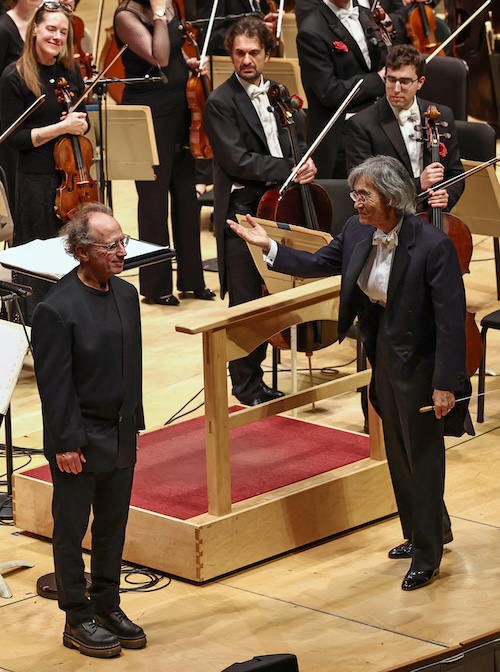
Conductor Kent Nagano acknowledges composer Tod Machover following the BSO world premiere of already and not yet. Photo: Winslow Townson
Nevertheless, Nagano, back leading the BSO for the first time since 1997, was firmly in command of the evening’s proceedings. While subsequent performances will surely grow in subtlety and impact, Thursday’s night’s debut was enough to provoke some deep thinking on the subject matter with which the music engages, which is not a feat all new works can claim.
Neither can all old ones, though the remainder of the night’s lineup—music by Mendelssohn and Alex Nante—managed better than not.
Mendelssohn’s Hebrides Overture, making its first appearance on a BSO subscription concert since 2016, received a roiling, shapely reading. Here and in that composer’s Symphony No. 5, Nagano mined an impressive depth of texture and sonority from the orchestra.
The latter, the so-called “Reformation” Symphony, was, on the whole, well-directed and lively. Though its second movement lacked a measure of vivaciousness, the section’s Trio was bright and tripping while the writing for low instruments at the beginning of the finale projected admirably.
That part’s closing quotation of Luther’s hymn, “Ein’ feste Burg,” was cleverly prefaced by the American premiere of Nante’s arrangement of Bach’s chorale (BWV 302) on the same tune. Lucidly scored and clearly shaped, the eponymous composition segued directly into the symphony—which, in turn, functioned as an apt illustration of the night’s larger vision of nature, divinity, technology, and democracy coexisting more or less amicably together.
The program will be repeated 1:30 p.m. Friday and 8 p.m. Saturday at Symphony Hall. bso.org
Posted in Performances
Leave a Comment

 Subscribe via RSS.