Brentano Quartet moves from darkness to light in final works by Shostakovich, Beethoven
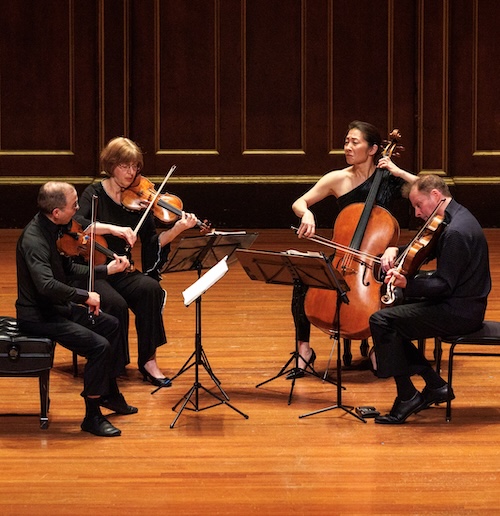
The Bretano Quartet performed Friday night at Jordan Hall, presented by Vivo Performing Arts. Photo: Robert Torres
Shostakovich finished his String Quartet No. 15 in E-flat minor, his final work in the genre, a year before his death. Beethoven finished his String Quartet No. 14, Op. 131, about eight months before his own passing.
The two works are closely linked: Shostakovich scholar Gerard McBurney has noted that Shostakovich’s score alludes to Op. 131. Yet heard side by side, their effects are completely dissimilar: the Shostakovich is unremittingly bleak whereas the Beethoven is far more varied and colorful.
The Brentano String Quartet brought both works to NEC’s Jordan Hall on Friday night, presented by Vivo Performing Arts. Each late quartet was preceded by a short fugue, which was an apt appetizer before the sizable works. It was a demanding program, and the quartet turned it into a remarkable artistic achievement.
Shostakovich’s Fugue in E-flat minor, from his extraordinary, Bach-inspired 24 Preludes and Fugues of Op. 87 opened the evening in an arrangement for string quartet. The arrangement did what the best transcriptions of keyboard counterpoint can do: respect the original but reveal its subtleties.
The two works share a key, and the ensemble proceeded directly into String Quartet No. 15 without a break.
Shostakovich wrote the Fifteenth for the Beethoven Quartet, the ensemble that had premiered nearly all of his quartets. However, during rehearsals in October 1974, its cellist, Sergei Shirinsky, died suddenly, and the Taneyev Quartet gave the first performance in Leningrad that November.
The quartet consists of six somber Adagios played without pause, and the Brentano made its opening Elegy almost unbearably still. The Serenade’s shrieks stayed animated and purposeful, its waltz just danceable enough to unsettle. Violinist Mark Steinberg dispatched the Intermezzo’s cadenza with complete command.
In the Nocturne, Brentano gave the silences as much deliberate attention as the notes. The Funeral March was full-toned and balanced even as its exposed lines turned violent. The Epilogue’s trills were so evenly proportioned it was difficult to believe human hands were playing them, and the effect was close to weeping. Brentano played the unnerving ending so sensitively that it felt like waking from a deep and unsettling dream.
After intermission, Bach’s Fugue in C-sharp minor, BWV 849, in an arrangement by Nicholas Kitchen, first violinist of the Borromeo Quartet, came as a shock. Clean, precise, and energetic, it sounded sanitary after the first half.
Beethoven’s String Quartet No. 14 in C-sharp minor, Op. 131, opens with its own fugue, and the Brentano styled the Adagio ma non troppo e molto espressivo as bittersweet rather than bleak. Where the Shostakovich kept its voices isolated, the Beethoven passed melodies among all four players with handoffs that were nearly imperceptible. The Allegro molto vivace brought the evening’s first major-key music, and the jolt was welcome.
The long Andante variations at the work’s center were handsomely played but registered with less individuality than what surrounded them. The Presto was where the second half came most alive, characterful and genuinely funny, with pizzicatos tossed around the ensemble that drew laughter from the audience. The brief Adagio quasi un poco andante made a gorgeous setup for a fiery Allegro finale.
Vivo Performing Arts presents Castle of our Skins in “Sacred Transcendence,” 3 p.m. Saturday at Twelfth Baptist Church. vivoperformingarts.org
Posted in Performances
Leave a Comment

 Subscribe via RSS.