Nelsons leads BSO in posthumous Gubaidulina premiere, in-process Mahler
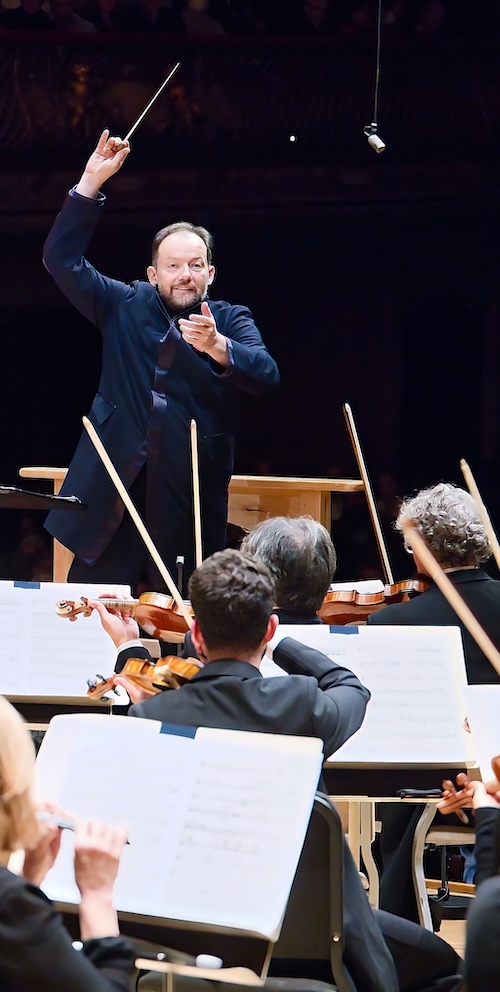
Andris Nelsons led the Boston Symphony Orchestra in music of Mahler and Gubaidulina Thursday night at Symphony Hall. Photo: Hilary Scott
“Muß es sein?” Beethoven scrawled at the beginning of the finale of his last string quartet. That conundrum (“Must it be?”) loomed large for Sofia Gubaidulina, whose music often wrestled with big philosophical questions like these—and frequently addressed them in unpredictable ways.
At her death in 2025, the 93-year-old Tatar-born composer left behind an incomplete Prolog that was co-commissioned by Andris Nelsons and the Boston Symphony Orchestra. On Thursday night, that work, finished by Gubaidulina’s friend and colleague Elena Firsova, received its world premiere from those forces at Symphony Hall.
Beethoven hovers over the twenty-minute score, but obliquely. As its title suggests, Prolog is intended as an introduction to Gubaidulina’s The Wrath of God, which itself was drawn from her 2016 oratorio, Über Liebe und Haß (On Love and Hate). Heard independently, the effort is a functional, if somewhat verbose, entry into the canon.
Slow, dense, and often dissonant, Prolog is music of great seriousness and drama. Textures accrete and dissipate; periodically, the mood brightens with the appearance of essentially diatonic chorales. At one point, a blazing climax implies a moment of triumph—but the bottom quickly falls out and the music’s dazed, scarred affect carries through to a devastating coda.
On Thursday, Nelsons and the BSO delivered a performance that was secure and, at times, exhilarating: the orchestra’s low-wind and expanded brass sections sounded already in mid-season form and many of the work’s dissonances glowed with uncommon purpose. Even Prolog’s most glaring compositional misfire—an extended aleatoric representation of chaos—was, on the whole, well-balanced.
Firsova, who was charged with completing more than two-thirds of the work, accomplished her task with commendable consistency: the music still sounds, by and large, like Gubaidulina. She was on hand to accept the audience’s robust cheers.
Given the context, it might have been welcome to follow Prolog with The Wrath of God. Instead, Nelsons and the orchestra assayed Mahler’s Symphony No. 7.
It has taken thirteen seasons, but the conductor, whose enthusiasm for the Austrian composer hasn’t always resulted in the most illuminating of Mahler interpretations, has now led the BSO in all nine of his completed symphonies. The Seventh, which was first heard in Prague in 1908, has generally stood out as the most enigmatic of his purely instrumental installments.
Like the Fifth, Mahler’s Seventh charts a course from darkness to light, though in this case the culmination comes in the form of an almost insistently ebullient Rondo-finale. As in the Sixth, echoes of nature and folk music—cowbells, mandolins, guitars—abound. If not the composer’s most popular work, it is perhaps his most singular and idiosyncratic.
However, Thursday’s account only infrequently embraced the music’s breathtaking originality.
Instead, the first two movements tended to meander. This was partly, but not entirely, an issue of tempo: Mahler eschewed metronome markings, but there is a range of approaches that can work in this symphony. Still, Nelsons’ handling of these sections lacked a crucial sense of purpose and narrative vigor. Even more puzzling, a want of nuance and atmosphere marked the BSO’s playing.
Where was the wonder, the excitement, the sense of discovery in this music? Too often absent or underemphasized. Small things—a sameness of character, blurry textures, uncoordinated downbeats and entrances—added up and the results, though hardly disastrous, were, at best, merely satisfactory. One would be hard-pressed to believe the orchestra hadn’t played this symphony since 2010. Then again, maybe not.
The Scherzo, perhaps the most wildly inventive and brilliant thing Mahler ever wrote was, on this night, velvety and flabby, lacking any semblance of a sharp, subversive edge. The waltz episodes were plush, nowhere near demonic enough. And, though the low strings’ snap pizzicatos were realized with terrific sonority, what should be charged rests afterwards packed little electricity or menace.
Unpromising as those first three movements were, the fourth, with its lush interplay of solos and studies of sonority, emerged with unfeigned beauty and elasticity. Here, for a good thirteen minutes, Mahler sounded in his natural element: shapely, sumptuous, urgent.
The finale continued that approach to a point—Nelsons’ tempos in fast music finally tended to be lively, and the BSO’s textures lean. But spotty ensemble of the kind that marred the first three parts was also in evidence and the diminuendo before the final blast barely approached mezzo–forte (the score indicates piano).
Nevertheless, the conductor’s supporters, out in full force, responded to the performance fervently. Certainly, some issues present on Thursday will work themselves out in subsequent concerts. Still, the overarching impression of the night’s account was of a reading very much in progress.
The program will be repeated 1:30 p.m. Friday and 8 p.m. Saturday at Symphony Hall. bso.org
Posted in Performances
One Response to “Nelsons leads BSO in posthumous Gubaidulina premiere, in-process Mahler”
Leave a Comment



 Subscribe via RSS.
Posted Sep 25, 2026 at 3:43 pm by EB Altman
I was so disappointed with the performance…glad to read that I am not alone. I have never been a Nelsons fan, and he took the life out of the piece. The obligatory standing ovation and the prolonged clapping, which I politely did, filled me with dismay. Had we been listening to the same performance?
When I go to a Thursday night concert, I don’t expect it to be a reading in progress; does that mean I have to go to the Saturday night concert to hear the quality I normally would expect?