Minkowski opens a new Boston Baroque era with a fresh and delightful “Seasons”
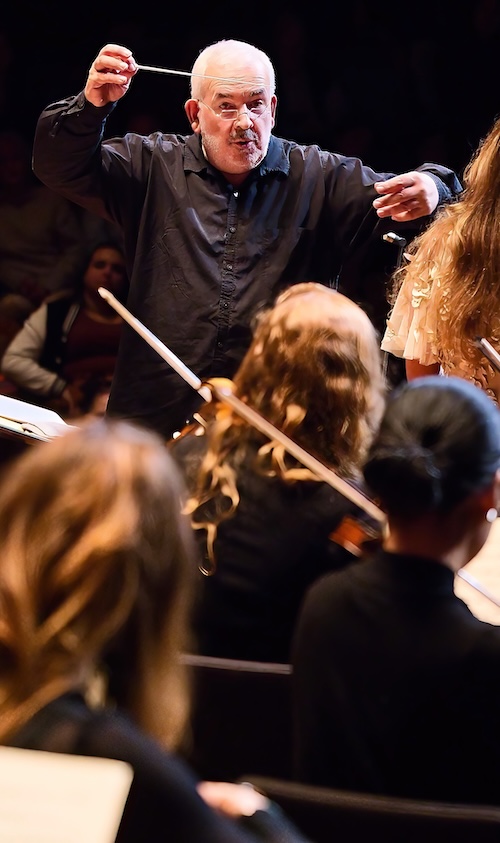
Mark Minkowsi conducted Boston Baroque in Haydn’s The Seasons Sunday afternoon at Jordan Hall. Photo: Hilary Scott
Composers don’t usually apologize for the music they write. But Franz Josef Haydn saw fit to put a disclaimer on the end of Part 2 of his oratorio, Die Jahreszeiten (The Seasons). “This whole passage with its imitations of the frogs,” he offered to an arranger tasked with crafting a piano version of the score, “was not my idea: I was forced to write this Frenchified trash.”
Be that as it may—and few musicians have brought to life the natural world better than Haydn, including in this episode—there is nothing trite or trivial about the composer’s larger setting of Gottfried van Swieten’s adaptation of James Thomson’s 1730 poem about the four quarters of the year.
As performed by Boston Baroque Sunday afternoon at Jordan Hall, this final large-scale undertaking from the Classical-era giant emerged as a masterpiece of freshness and invention. Accordingly, it made a fitting monument to open Marc Minkowski’s tenure as the group’s new music director.
First performed in Vienna in 1801, The Seasons is clearly related to Haydn’s The Creation, which it post-dates by three years. The style and syntax are similar: both works call for the same trio of soloists (soprano, tenor, and bass), plus chorus and orchestra. The structuring of the former is somewhat more varied than the latter—a pair of cavatinas dot parts two and four and echoes of folk song abound. If the choral writing isn’t quite so magisterially tuneful in the later work, it is still brilliantly energetic and ingeniously contrapuntal.
Where The Seasons is decidedly inferior to its predecessor is in its libretto. Swieten largely refashioned Thomson’s lengthy blank-verse poem, adding three characters (Hanne, Lukas, and Simon) whose lines tend to echo those of the chorus without adding enough dramatic purpose to justify their inclusion. Meantime, the work’s mix of Arcadian imagery and Enlightenment Deism never quite gel; the final movement’s “Amens”—among the The Seasons’ few explicit religious exclamations—are unexpectedly jarring. Not for nothing did the composer grumble about the text’s lack of poetic cohesion
Nevertheless, the music that resulted is among the most vivid in Haydn’s oeuvre. Sunday’s performance, which clocked in around the two-and-a-half-hour mark (including intermission), never wanted for direction or intensity. Rather, it bristled.
Much of that owed to the genial Minkowski, who is just Boston Baroque’s second chief conductor after founder Martin Pearlman stepped down in 2025. The 63-year-old Paris native’s beat is animated, his overall stage presence spirited; at several points in the afternoon, he appeared to be cuing his forces while patting the top of his head.
If that seemed unorthodox, the results the conductor drew from singers and players were nothing if not shapely and propulsive. The orchestral introductions to each of The Seasons’ four sections were models of contained drama, from the snapping, stormy rhythms of “Spring” to “Winter’s” moody chiaroscuro.
As were the work’s many demonstrations of text painting. In addition to the chorus of frogs, there’s a magnificent depiction of a sunrise in “Summer” that might outdo that in The Creation; Sunday’s take on that moment blazed. Haydn’s evocation of the revelries of country folk in the last half of “Autumn”—think Beethoven’s “Pastoral” Symphony blown up onto a massive canvas—was a riot of color and spirit, a quartet of horns on either side of the orchestra leading the way with raucous exuberance.
In that one part (“Hört! Hört das laute getön”), balances between voices and instruments were a bit touchy. But, as with much of the rest of the afternoon’s presentation, the music’s larger atmosphere was mightily realized.
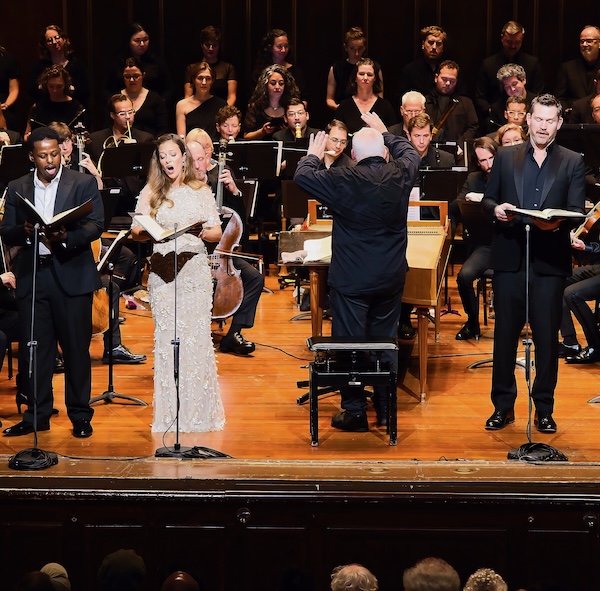
Tenor Andrew Turner, soprano Lauren Snouffer and bass-baritone Brandon Cedel were the soloists in Boston Baroque’s The Seasons. Photo: Hilary Scott
Sunday’s trio of soloists distinguished themselves individually and corporately.
Soprano Lauren Snouffer brought purity and light to her several turns, her silvery instrument easily floating its top notes and never struggling to project in its lower tessitura. She made the most of Hanne’s part, imbuing her two songs (with choral accompaniment) in the “Winter” section with particular wit and charm.
As Hanne’s betrothed, Lukas, tenor Andrew Turner brought appealing resonance and clarity to his role. His jaunty duet with Snouffer (“Ihr Schönen aus der Stadt”) evinced a strong chemistry between the pair and the American singer’s account of his cavatina (“Dem Druck erlieget die Natur”) was a commanding demonstration of inwardness and urgency—even as it was marred at the end by the jangle of a cell phone (one of at least four that made its presence known over the concert’s first half).
Meantime, bass-baritone Brandon Cedel brought weight and style to the part of Simon. His opening aria, “Schon eilet froh der Akkermann,” was a picture of burly whimsy while “Erblicke hier, betörter Mensch,” a meditation on the transience of life, rang with fitting gravity.
The soloists’ ensemble numbers blended well with each other, as well as with the Boston Baroque Chorus. That group, 34 voices strong, delivered their parts with gusto, especially the lusty countryside scenes of “Autumn.”
All the singers, too, navigated The Seasons’ German texts with exemplary clarity. The program book provided just an abridged English translation of the libretto, but the work of all involved was so articulate that one could easily tease out the original words, even in some of the score’s denser polyphony.
A full house cheered enthusiastically, sometimes encouraged after a particularly robust chorus or solo by Minkowski. The conductor proved a charming emcee, offering pithy commentary before each of The Seasons’ sections and, at the end, quieting a rousing ovation to encourage people to attend future concerts and consider becoming donors. “When I’m in France, I don’t [make such appeals],” he said, somewhat sheepishly, of the last. “But I’m told that here…” He didn’t finish the sentence—or have to.
One concert certainly doesn’t foretell the ups and downs of a multiyear appointment. But, on the merits of Sunday’s season opener, Boston Baroque chose wisely with Minkowski and now stands on the cusp of a bright era.
Boston Baroque’s X-tet presents music by Vivaldi, Albinoni, Castello, Handel, Archilei, Agnesi, and Jacobsen 7:30 p.m. November 13 & 14 at Seully Hall. baroque.boston
Posted in Performances
One Response to “Minkowski opens a new Boston Baroque era with a fresh and delightful “Seasons””
Leave a Comment
 Subscribe via RSS.
Posted Sep 21, 2026 at 3:05 pm by David
Simply wonderful! Hard to imagine a better performance of this piece.