Dystopian staging apart, BLO does Rossini proud with “William Tell”
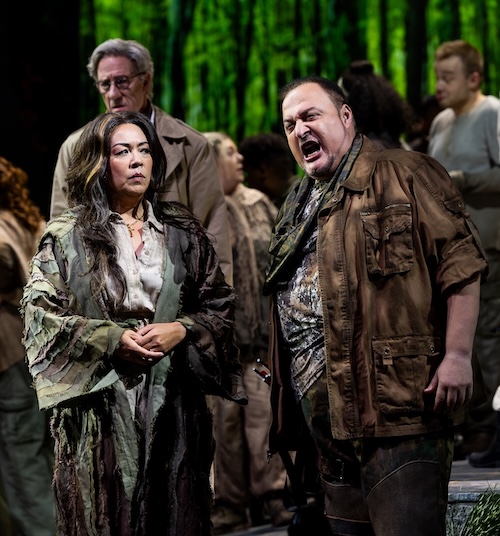
George Gagnidze in the title role and Nina Yoshida Nelsen as Hedwige in Rossini’s William Tell at Boston Lyric Opera. Photo: Nile Scott
Subtlety may deceive you, Oliver Cromwell warned. Integrity never will.
The adage would apply, it seems, both to the title character in Rossini’s opera William Tell—he’s a man of action and his word—and to Boston Lyric Opera’s new production of the same. Heard on Sunday at the Emerson Colonial Theatre, this 50th-anniversary season-opener is well-cast, -sung, and -played. Yet the staging by Victoria Tzykun and David Adam Moore sometimes veers a bit insistently into dystopian tropes: think The Hunger Games goes to the opera.
Not that Rossini’s epic, premiered in Paris in 1829, is a study in sunshine and light. Rather, its plot roughly follows that of Friedrich Schiller’s play on the eponymous Swiss folk hero. The Helvetians, oppressed by the tyrant Gessler (a puppet of the Austrian Hapsburgs), yearn for their freedom. They band together around Tell, a legendary marksman, who, in a daring feat, shoots an arrow through an apple resting on his son’s head. The masses, inspired, rise up against their overlords and, eventually, gain their autonomy.
To this basic narrative, Rossini’s librettists, Victor-Joseph Étienne de Jouy and L. F. Bis, added further complications, including a romance between Arthur, the son of the Helvetian scion Melcthal, and Mathilde, a Hapsburg princess. So much of the opera’s drama turns on the actions of that pair, in fact, that the title character emerges, over the first part of the drama, as something of a mythic, two-dimensional cutout.
Tell is humanized, though, over its second half, first, coming to terms with the horrifying prospect of pitting his marksmanship against his child’s life. (In the traditional legend, Schiller’s play, and Rossini’s libretto, the character is designated as Tell’s son; BLO’s production sensibly switches this to a daughter: the role is written for a soprano and nearly always sung by a woman.) Then, in the concluding act, Tell leads his countrymen to victory on the battlefield.
George Gagnidze’s account of the title role ably captured Tell’s vital qualities of leadership and charisma. The Georgian baritone possesses a powerhouse instrument—as well as a commanding physical presence. He put both to potent use in the militant scenes in Act 2, as well as his character’s defiant showdown with Gessler in Act 3. But he also brought a commendable tenderness to that same scene’s “Sois immobile,” in which Tell takes leave of his child before making the fateful shot. The hero’s Act 4 reunion with his family, too, was touchingly cathartic.
As Tell’s daughter, Jemmy, Brianna J. Robinson clearly channeled the father’s obduracy. She sang with outstanding spirit and brilliant tone, dominating the stage in her handful of solos and scenes like a star in the making.
Konu Kim’s Arnold was likewise compelling. His is a famously unforgiving part—the fearsome aria, “Amis, amis, secondez ma vengeance,” doesn’t arrive until Act 4 and it’s prefaced by a series of only lesser-demanding numbers—but the Korean tenor navigated the role’s requirements with unfailing ease. Early or late in the afternoon, he never seemed to be forcing the high notes and the sonority of his voice across its range was consistently appealing.
As Mathilde, Anya Matanovič soared in her upper register but sometimes struggled to project lower down, both in Act 2’s “Sombre forêt” and during the climactic rescue of Jemmy at the end of Act 3. Nina Yoshida Nelsen’s Hedwige exuded matronly security, as well as frantic concern at her family’s fate in Act 4.
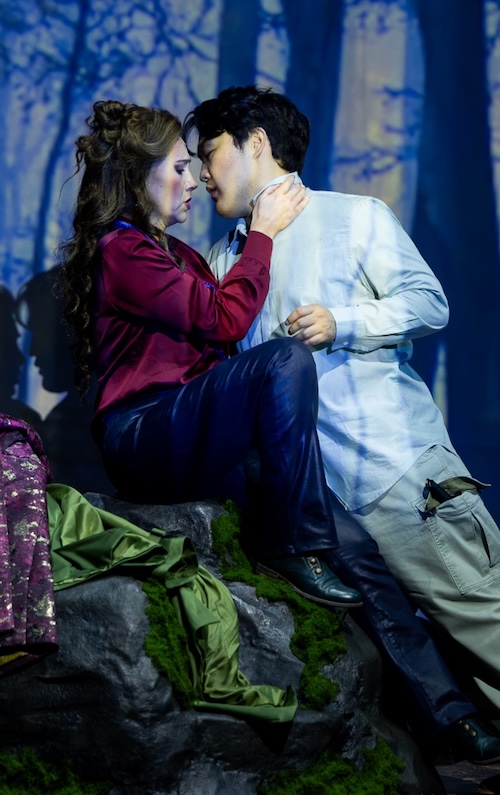
Anya Matanovic as Mathilde and Konu Kim as Arnold in BLO’s”William Tell.” Photo: Nile Scott
Given the villainous demeanor of Hunter Enoch’s Gessler, the latter emotion was entirely fitting. So effective was the bass-baritone as well as his henchman, Yeghishe Manucharyan’s Rudolf—that the pair seemed to receive a few boos during the afternoon’s curtain calls.
James Demler’s ill-fated Melchtal was sung with warmth and nobility. Similarly, Sergio Martinez and Ilya Silchukou brought impressive resonance to the smaller parts of Walter and Leuthold, respectively, while Morgan Mastrangelo imbued the role of Ruodi with sweet sincerity.
The BLO Chorus, prepared by Brett Hodgdon, delivered their parts with good blend and a welcome tonal depth. Meanwhile, David Angus drew playing of spirit and color from the BLO Orchestra.
One would be hard-pressed to locate this Tell’s action in Switzerland. Aside from a quick staging shot with an Alpine background in Act 1 and a video montage of wildflowers at the end of Act 4, Tzykun and Moore—who also serve as the production’s scenic, costume, and projection designers—have updated and anonymized the opera’s setting. That’s all good and well: oppression knows no borders or timeframes. In a note, Tzykun relates growing up in the Soviet Union (“I know what it means to live under authoritarianism,” she writes. “Freedom is never free”). How is one to argue with that?
Still, the approach has the effect of negating some of the score’s lighter musical touches and the production’s anachronisms—the haves with their iPhones and masked police protectors, the Helvetians in their rags and armed with crossbows (later dynamite, drones, and guns)—ultimately feel like too much of a hard sell.
The relative lack of complexity that emerges begs the question: can an audience be allowed to process ambiguity? Or do they need to be guided to the proper conclusions step-by-step? Is one option more freedom-loving than the other?
Given the titters that greeted Arnold and Mathilde’s Act 2 tryst, there may be a case to be made for the second choice. That said, considering how effectively the final act, with its depictions of a countryside in rebellion, a storm-tossed lake, and that Elysian meadow matched the scope and grandeur of the music, it was hard to come away from Sunday’s performance not wishing for a bit more nuance earlier in the opera.
Adding to the sense of compression, oddly enough, were the extensive cuts BLO made to Rossini’s score. This is, of course, standard practice: the full opera runs nearly four hours and, even at two-and-a-half, its plot is overstuffed. Yet some of the excised choruses and dances might have provided the lift and variety needed to bring Tzykun and Moore’s concept fully to life.
Nevertheless, Sunday’s performance made more than a few valuable and timely points about honor, courage, loyalty (to ideals as well as one’s neighbors), and sacrifice. In so doing, it ended up vindicating both Tzykun and Cromwell. Freedom isn’t free—and integrity will never deceive.
Boston Lyric Opera presents Rossini’s William Tell, 7:30 p.m. Friday and 3 p.m. Sunday at Emerson Colonial Theatre. blo.org
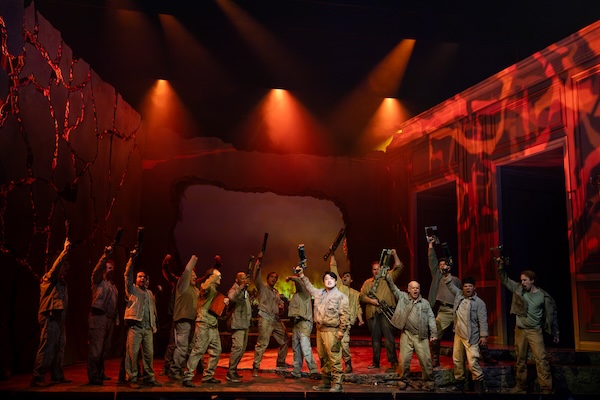
Photo: Nile Scott
Posted in Performances
One Response to “Dystopian staging apart, BLO does Rossini proud with “William Tell””
Leave a Comment
 Subscribe via RSS.
Posted Sep 28, 2026 at 2:30 pm by Martha Segal
I saw the Friday evening opening night performance. I wondered if the choice of this opera right before the midterm elections was deliberate because it certainly is timely.
I agree with the above review in terms of the singing. I was excited to hear George Gagnidze and he delivered. During the first two acts there was some unevenness in the orchestra and the pacing seemed off. The second two acts had a better flow.
I had read a detailed synopsis prior to attending and was glad I did because otherwise the action on stage would not have made sense due to the cuts. This could have been addressed by having a good synopsis in the program instead of the terse little paragraph that did nothing to elucidate the plot or the themes. Recommendation: put some effort into the synopsis of future productions.
Finally, I could not discern any of the themes or leitmotifs from the overture during the performance. I don’t know if this is just the way the opera was written or whether these themes were present in the cut portions. I listened to the overture several times after coming home and could appreciate how the themes correlated with the plot.