A Boston Symphony opening night of strong emotions with Nelsons and Ma
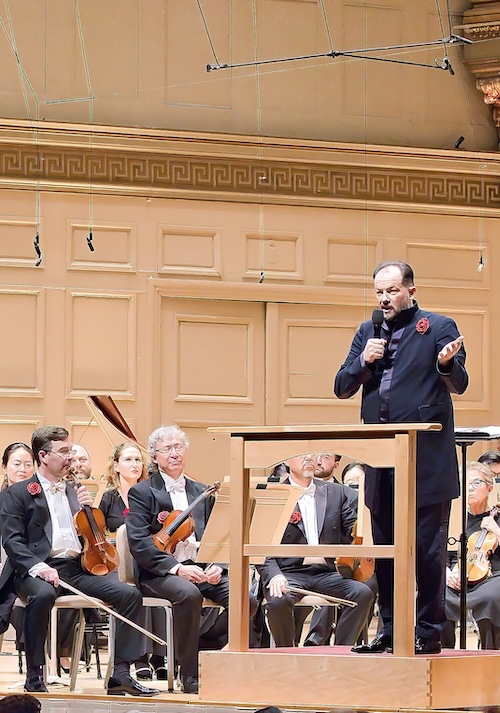
Andris Nelsons addressed the audience before the Boston Symphony Orchestra’s season-opening concert Thursday night. Photo: Hilary Scott
“You may ask, ‘Why do we wear the roses?’” said Andris Nelsons in a rare statement from the stage at the Boston Symphony Orchestra’s season-opening concert. “It’s a sign of love, admiration, respect, and compassion—for us and each other.
“The music is about love, excitement, inner dreams, brotherhood, darkness, and, at the end, moments of sun and positivity. I love this orchestra from the bottom of my heart. We love you, our audiences.”
The deeply felt comments came from Nelsons, at the opening of what will be his final season in Boston. Last March, the BSO’s board announced they would not renew his contract, prompting waves of support for Nelsons locally and globally. Against that backdrop, the evening’s opening program of music by Arturs Maskats, Edward Elgar (with Yo-Yo Ma), and Johannes Brahms seemed invested with even more passion than usual.
Nelsons opened with Tango, a piece by his friend and former colleague Arturs Maskats, whom he worked alongside for a decade at the Latvian National Opera.
The roughly 12-minute work dances between lush tango-infused melodies, declarative percussion and brass, and sensitive bandoneon playing from Julien Labro, each phrase filled with romantic longing. Nelsons led a commanding performance of Tango and decisively shepherded the emotional highs and lows.
For Elgar’s famous Cello Concerto in E minor, Yo-Yo Ma led the way. The concerto’s opening is usually played with force and deep passion, but Ma chose a melancholy softness instead, perhaps suited to the occasion. The approach carried through the first movement: every pianissimo was controlled and deliberate, and the exposed, delicate playing was absolutely captivating.
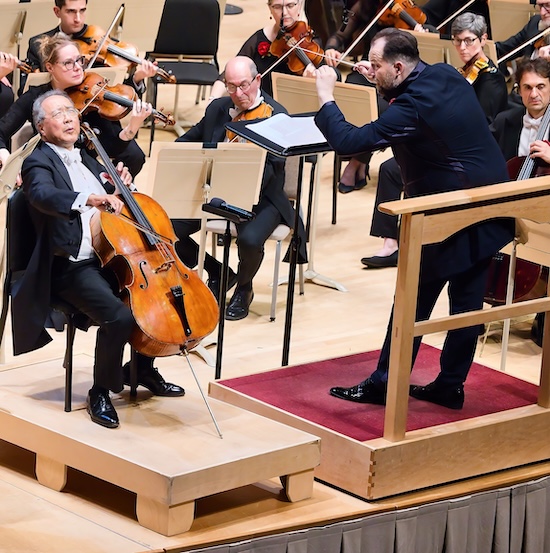
Yo-Yo Ma performed Elgar’s Cello Concerto with Andris Nelsons and the BSO Thursday night. Photo: Hilary Scott
The Lento–Allegro molto brought a tender joy with jaunty, playful energy. Ma’s virtuosic cello runs seemed effortless.
The Adagio movement offered the finest music-making of the evening. Ma and the orchestra hit every mark with playing full of heart and sorrow. The finale arrived like waking from a dream, returning to more traditional force before carrying the concerto to a close. The standing ovation was immediate.
Ma then took the last chair of the cello section for an unannounced encore of Pablo Casals’ El cant del ocells (The Song of the Birds),, another heartfelt work that extended the evening’s emotional thread.
Brahms’s Symphony No. 4 in E minor followed intermission. The first movement echoed the Maskats in character, but the emotional thread of the first half wasn’t quite there, feeling like a work in progress.
The strings shone in the Allegro non troppo’s lilting opening theme with warmth, and the movement’s contrapuntal density always clear.
A graceful clarinet solo opened the Andante moderato, its processional melody giving way to mournful orchestral colors that revealed the symphony’s pathos clearly. The ensuing Allegro giocoso provided a jolt, its pounding two-beat energy nearly symphonic-finale force in its own right.
The finale, Allegro energico e passionato, turned the evening dark. Brahms’s chaconne variations built relentlessly over a repeating bass, brass and percussion driving toward the close. Nelsons seemed particularly passionate here, shaping the movement’s mounting intensity with visible conviction and confidence. Following this superbly played Brahms performance, a standing ovation ended the night.
Andris Nelsons conducts the BSO in Berlioz’s Symphonie fantastique and Mozart’s Piano Concerto No. 22 with Emanuel Ax 1:30 p.m. Friday and 8 p.m. Saturday at Symphony Hall. bso.org
Posted in Performances
3 Responses to “A Boston Symphony opening night of strong emotions with Nelsons and Ma”
Leave a Comment


 Subscribe via RSS.
Posted Sep 18, 2026 at 3:45 pm by David Stern
Looks like Andris is taking the high road in his final year but it will be his final year and the end of an era for the BSO. I dread to think what the future holds given the vague and amateurish statements made by the BSO board.
Posted Sep 20, 2026 at 11:25 am by Joseph Kane Sr
I have followed Nelsons’ career for years. The BSO management is making a serious mistake. JJK Sr
Posted Sep 22, 2026 at 5:34 pm by Stephen Goldstone
As a Brit, I transit by ship to New York and was privileged to have attended this special inaugural concert of the series.
I found Yo Yo Ma’s interpretation non-Elgarian in lacking projection and power, despite his obvious technical abilities. The Brahms Symphony was notable for its expansiveness and power.