Pianist Han Chen finds connections among far-flung works
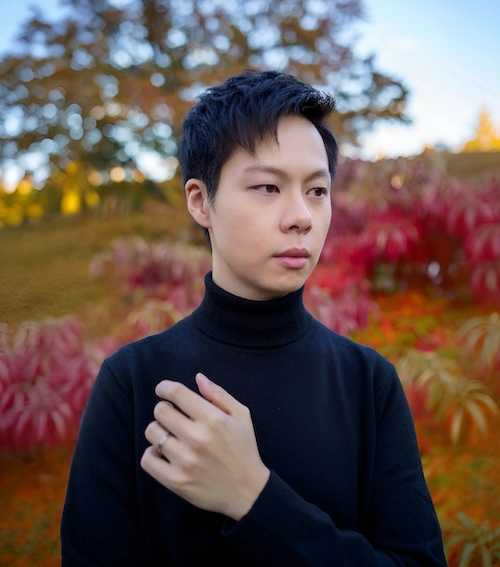
Han Chen performed a recital Friday at NEC for the Chinese Society of Performing Arts. Photo: Zhenwei Liu
Usually, a great pianist will show you their skill with sound. On Friday night, Han Chen showed his artistry with silence.
Appearing at New England Conservatory’s Williams Hall in the Foundation for Chinese Performing Arts’ summer series, the Grammy-nominated Taiwanese pianist presented an intriguing program of contrasting works by Beethoven, Nina C. Young, Liszt, and Stravinsky.
He began with a farewell. Beethoven’s Piano Sonata No. 26 in E-flat major, “Les Adieux,” was written in 1809 as his patron Archduke Rudolph fled the French occupation of Vienna. Chen’s “Lebewohl” was slow and methodical, with the singing lines drawn out, the left hand dark but never heavy. The Allegro section brought out the hallmark Beethovenian contrast, and Chen made it feel fresh and dynamic. In “Abwesenheit,” he shaped the melody with remarkable sensitivity, and the silences were perfectly moulded between phrases. Only in “Das Wiedersehen” did the writing demand genuine virtuosity. It was an unconventional opening, and it established Chen as a Beethoven interpreter whose instincts are fundamentally poetic.
Nina C. Young’s Fern Flower (Tsvetok Paporotnika) was heard in its world premiere. The work takes its title from the Slavic legend of a blossom that appears one night a year and grants hidden knowledge to whoever finds it. Young’s piece opens low and dismal, a trudging quarter-note tread in the left hand that suddenly leaps to the top of the instrument for twinkling, frantic trills before dropping into mid-range fragments. Bell tones and recurring motives accumulate across a largely whole-tone harmonic field. Chen handled the massed runs and trills with great control, offering a polished interpretation and invoking a magical landscape.
Liszt’s Funérailles, written in October 1849 as an elegy for the Hungarian revolution crushed that year, ended the first half of the program with a true virtuosic test. Chen alternated forceful declamation with passages of real sweetness, and the famous octave passage was percussive yet rhythmically driven, never turning muddy.
The second half was devoted entirely to Stravinsky. The Quatre études, Op. 7, written in 1908 while the composer was still studying with Rimsky-Korsakov, are built around rhythms more than melodies, and this is where Chen’s technique came to the fore. The first movement pressed ahead urgently; the following Allegro brillante matched it with more lightness and high-register sparkle. The Andantino turned tender and twinkling, an unexpected echo of the earlier Beethoven, before the final movement tore past so quickly it was over almost before it began.
Stravinsky’s 1924 neoclassical Piano Sonata was composed the same year he began appearing publicly as a pianist. The outer movements share a tempo marking and a puckish, stop-start humor that Chen played charmingly. The Adagietto floated agreeably on waltz figures and trills, its ornaments spun out with a lightness that also recalled Beethoven earlier in the evening. The finale felt almost like a game, its frantic lines resolving into an unexpectedly soft close. Chen navigated all of it with precision at speeds that would trouble most players.
Chen closed with Trois mouvements de Petrouchka, Stravinsky’s own 1921 piano reduction of his ballet, and one of the most punishing scores in the piano repertoire. Chen dispensed the “Danse Russe” with no sign of strain. “Chez Pétrouchka” turned dreamlike, then anxious. “La semaine grasse” closed the program in a pastoral rush of mid-register ostinato, lively and full of spirit.
The Young premiere apart, Chen played the entire program from memory and the standing ovation was immediate. For an encore he offered his own composition, Spring Breeze, a Chopin-esque piece that cleansed the palate after the dense Stravinsky.
The Foundation for Chinese Performing Arts continues its summer series with a chamber program 7:30 p.m. Sunday at NEC’s Williams Hall. chineseperformingarts.net
Posted in Performances
Leave a Comment

 Subscribe via RSS.