Nature-inspired works prove most successful in Boston Landmarks finale
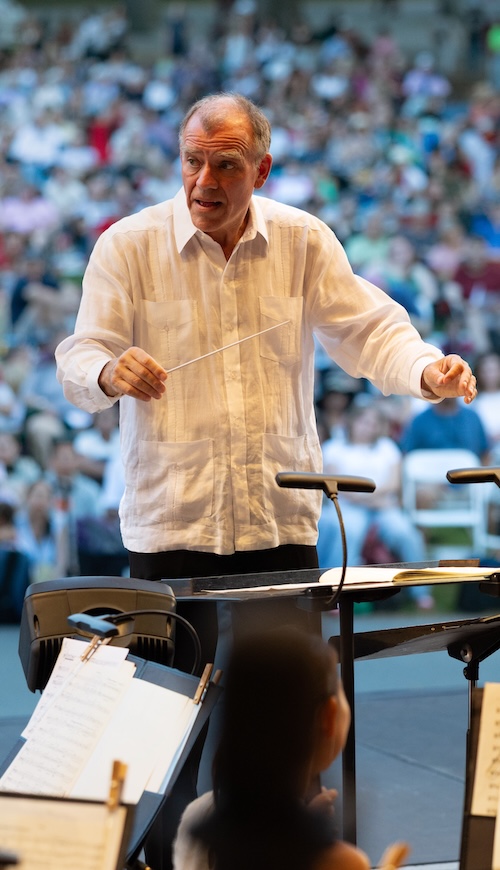
Christopher Wilkins conducted the Boston Landmarks Orchestra Wednesday night. Photo: Michael Dwyer
The Esplanade was packed for the finale of Boston Landmarks Orchestra’s 25th anniversary. Even the geese showed up on cue, both onstage and off.
Christopher Wilkins led the Boston Landmarks Orchestra at the DCR Hatch Shell Wednesday night, in partnership with the Esplanade Association, which marked the same milestone this year.
In the evening’s prelude students of the Boston String Academy offered game if rough-hewn playing in short works by Sibelius, Gardel, Bernstein, and Gabriela Lena Frank. Organist Eddie Zheng followed with the “Fantasie” from Florence Price’s Suite No. 1 for Organ, music that deserved an indoor venue. The audience was still noisily settling into their seats, amplification blunted his articulation, and the rush-hour traffic loomed distractingly.
Wilkins announced the occasion from the stage, framing the program in the tradition of the “Green Concerts” that the Landmark Orchestra’s founder Charles Ansbacher established: nature-inspired music for a park setting.
As such, the concert proper began with the energy and freshness of Mendelssohn’s The Hebrides. Wilkins shaped every gesture for maximum pathos, and the strings played with real bite. Repeating crescendos and swells gave the overture its characteristic sway, echoed in the lower strings’ rocking figures. For a Romantic work, The Hebrides retains a Classical brightness, and a fine solo woodwind line appeared with Mozartean poise. The finale was dramatic, its hammered declarative chords landing with insistence.
Anna Clyne’s Wild Geese followed naturally. Taking its title from a poem by Mary Oliver, the piece opens mysteriously, wings fluttering in winds and horns over a bed of held chords, with honks from the trumpet. Scalar figures scattered through the violins and, right on cue, Boston geese crossed the Esplanade, drawing a laugh from the audience. The work oscillates between sustained ambiguous harmony and dense polyphonic scurrying, and proved charming throughout.
Respighi’s Fountains of Rome closed the first half. The suite’s four linked movements trace a single “Roman” day. “The Valle Giulia Fountain at Dawn” was fragile and sparkling, well matched to the sun going down over the Charles River. Soft bells bid farewell to “The Villa Medici Fountain at Sunset,” and to the daylight. The geese, not having been told the Clyne had ended, continued to contribute.
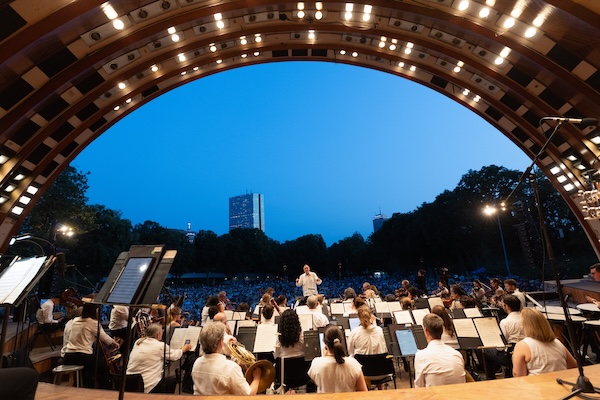
Photo: Michael Dwyer
The first half of the program produced fluent and natural playing from the orchestra. The second half, which left the nature thread behind, proved less consistent.
Beethoven’s Leonore Overture No. 3 opens in darkness, its descending line tracing Leonore’s step into the dungeon where her husband Florestan is held, and darkness had duly fallen over Boston. But the piece suffered pronounced balance issues. The amplified flute struggled to be heard, unaided by loud passing motorcycles. The offstage trumpet call cut through and recaptured the crowd’s attention.
Saint-Saëns’ Symphony No. 3 (“Organ”) proved uneven in a way the first half never was. The opening “Adagio–Allegro moderato” had wit and charm but was wanting in bite and focus. The “Poco adagio” brought organist Zheng’s first entrance, a low sustained presence beneath a pastoral calm, and here the long melodic lines were warm and open.
The scherzo section picked up energy, with bright filigree from the electric piano and early hints of the finale’s great tune. When the Maestoso finale arrived, Zheng’s organ blazed through the amplification and the strings answered beautifully, though the ensemble slipped and coordination between podium, orchestra, and organ briefly came apart. Wilkins recovered the thread, Zheng’s next entrance landed cleanly, and whatever the players had been holding back went into the exciting closing section.
Posted in Performances
Leave a Comment
 Subscribe via RSS.