BSO gives Glass’s “Lincoln” Symphony a noble sendoff at Tanglewood
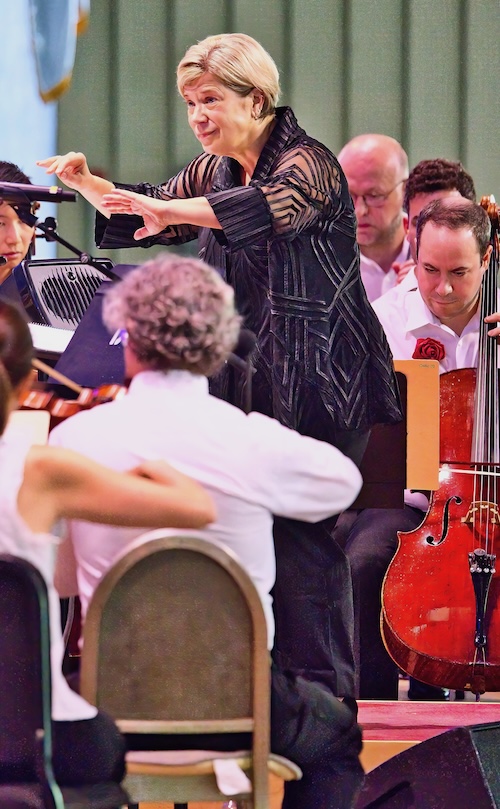
Karen Kamensek conducted the Boston Symphony Orchestra in the world premiere of Philip Glass’s Symphony No. 15 “Lincoln” Sunday at Tanglewood. Photo: Hilary Scott
Abraham Lincoln’s words aren’t often set to music: among other things, his oratory possesses what Robert Frost called the “sound of sense,” which doesn’t require extra-verbal assistance.
But that hasn’t stopped Philip Glass from appropriating the 16th president as a character in three of his theater works and, now, his Symphony No. 15, which received its world premiere from the Boston Symphony Orchestra Sunday at Tanglewood.
Written between 2021-23, Glass’s “Lincoln” Symphony takes various utterances from the American icon—excerpts from his 1838 Lyceum Address and Autobiography, as well as extracts from speeches on slavery, the end of the Civil War, and the president-elect’s farewell address to friends and supporters in Springfield, IL—and offers them as a type of commentary for our own times.
Fittingly, the effort has been caught up in this semiquincentennial year’s cultural tumult. Originally slated to be debuted in the nation’s capital at the Kennedy Center, Glass withdrew the score in January, citing concerns about the venue’s “values” under the current administration. Into the breach stepped the BSO, which promptly scheduled a premiere for Tanglewood.
The rescheduled symphony debut came off as planned Sunday afternoon in Lenox. Baritone Zachary James intoned Lincoln’s famous warning that “[if] destruction be our lot, we must ourselves be its author and finisher.” Karen Kamensek led the BSO with a sure hand and a firm command of Glassian style.
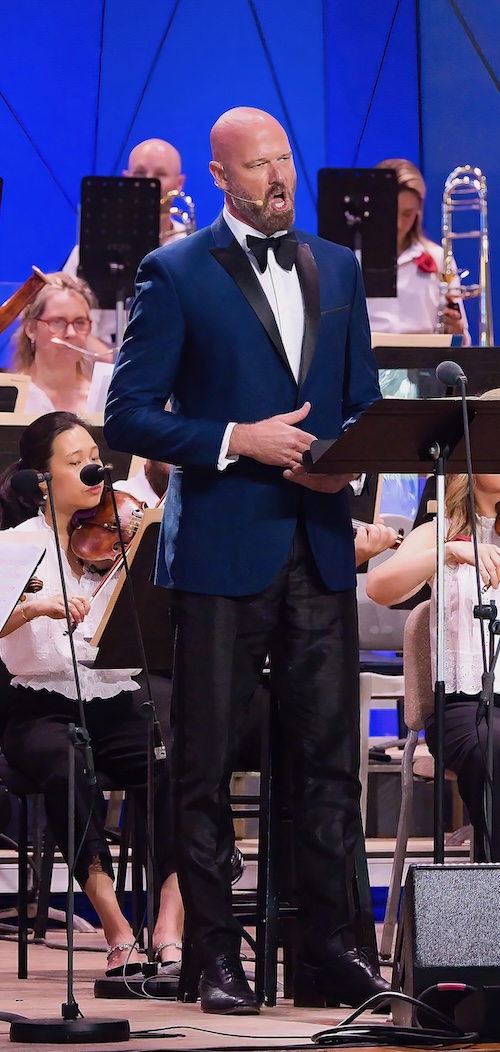
Baritone Zachary James was the soloist in Glass’s “Lincoln” Symphony on Sunday. Photo: Hilary Scott
The last is a recognizable quantity and, for better or worse, the Symphony No. 15 doesn’t break much new ground in terms of harmonic or rhythmic content. Instead, the 35-minute-long score traffics in the familiar arpeggiated gestures and layering of subtle metric dissonances that have been a hallmark of the composer’s language for more than fifty years. The combination remains largely hypnotic and effective, though the score’s eight movements would benefit from a greater variety of tonal and textural contrast, especially to emphasize the libretto’s more dramatic turns.
That said, certain of the music’s understated moments, particularly those involving the Lyceum Address and Lincoln’s farewell, are enhanced by the essentially unflashy nature of Glass’s setting. The composer, 90 next January, doesn’t shy away from extended moments of brightness and sheer beauty. The final bars are haunting.
Throughout, Glass’s experience in the cinema seems to infuse the work’s structure—though that, in turn, raises questions of content and form. In particular, splitting the Lyceum and Autobiography movements into two sets of two seems haphazard. Ultimately, the whole score feels more like a documentary-style cantata than a unified symphony.
Nevertheless, baritone James, who was making his BSO and Tanglewood debuts, navigated the work’s vocal part—which involves a mix of sung and spoken episodes—with stirring confidence. Kamensek drew a smartly paced reading from her forces. While the Koussevitzky Shed hardly rivals Symphony Hall for acoustic excellence, the orchestra’s playing was consistently precise, well-blended, and marked by a strong sense of occasion. Glass was on hand to bask in warm cheers afterwards.
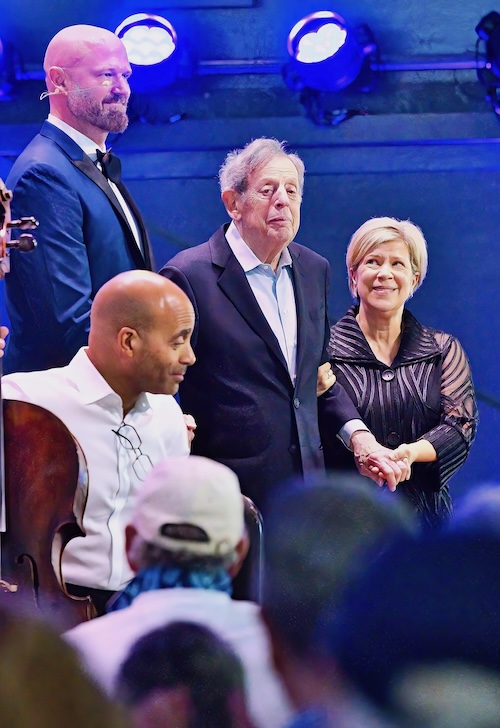
Philip Glass takes a bow with Zachary James and Karen Kamensek following the debut of the “Lincoln” Symphony. Photo: Hilary Scott
Kamensek, who was also making her BSO debut, was on equally firm footing in the afternoon’s remaining fare, all of it Lincoln-themed.
Aaron Copland’s Lincoln Portrait may suggest propagandistic bombast—its rafter-raising final bars seem tailor-made to provoke a response—but there’s a considerable degree of musical sophistication leading up to that double-bar.
Those strengths emerged impressively in Sunday’s traversal of this 1942 chestnut, which leaned into the music’s grand, stentorian declamations; sweet lyricism; vigorous playfulness; and brilliant instrumentation in about equal measure. Making his own BSO debut, Alec Baldwin delivered the work’s uplifting narration with vigor and clarity.
Music from John Williams’s score to Lincoln filled out the afternoon. Though much of it sounded like imitation Copland, the suite’s four sections—“The People’s House,” “Getting Out the Vote,” “Elegy,” and “With Malice Towards None”—were played with a touching warmth and a sense of ownership that only the BSO, with its long history with the composer, can boast.
The Boston Symphony Orchestra plays music by Tchaikovsky 8 p.m. Friday at Tanglewood. bso.org
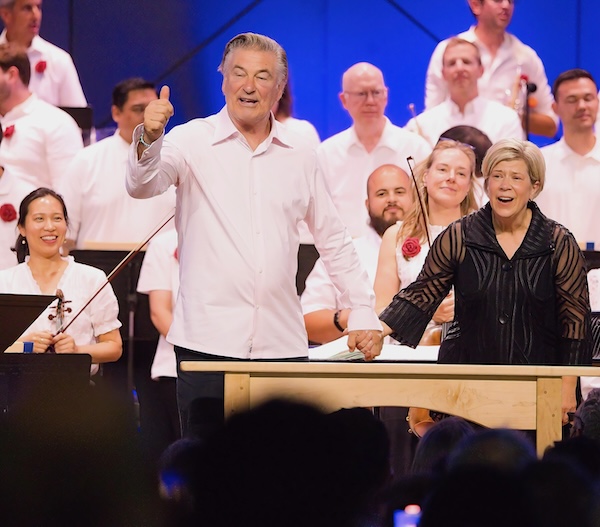
Alec Baldwin was the narrator in Copland’s Lincoln Portrait with the BSO. Photo: Hilary Scott
Posted in Performances
Leave a Comment
 Subscribe via RSS.