A mixed indoor night with Landmarks Orchestra
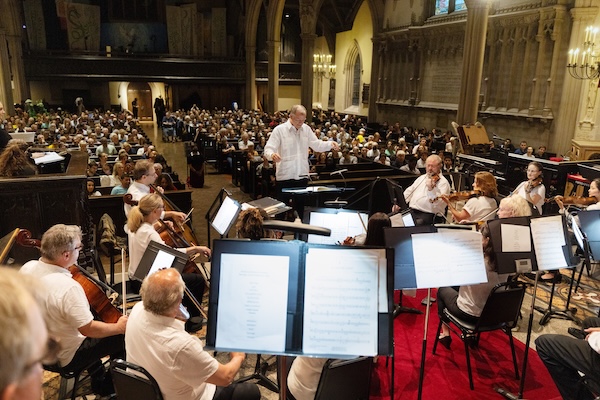
Christopher Wilkins conducted the Boston Landmarks Orchestra Wednesday night at Emmanuel Church. Photo: Michael Dwyer
“Things happen in life. We pivot.”
That show-must-go-on greeting from conductor Christopher Wilkins opened the Boston Landmarks Orchestra concert Wednesday night—not at the usual Hatch Shell but indoors at Emmanuel Church, where the weather-driven change bestowed a reverent feel.
Following a prelude concert by Four Strings Academy, the concert proper began with“Nimble Feet,” the first of Florence Price’s Dances in the Canebrakes, orchestrated by William Grant Still. After a generous tuning, the players brought a soft, rounded character to the rag, with the church acoustic sweetening its jazzy edges. Still’s own “Summerland” followed, and the room served it even better. Written as a portrait of the afterlife, the piece is streamlined and ethereal, and the players leaned into its chromatic turns.
The centerpiece was Max Richter’s Recomposed, with violinist Michael Jorgensen making his Landmarks debut. Chair of the music department at Lehigh University, Jorgensen is also director of the Violin Workshop at Boston University Tanglewood Institute.
Richter’s work—quoting Vivaldi in fragments, then looping and layering what remains into something post-minimalist—asks for absolute precision, and the evening’s conditions did not help. Jorgensen’s wayward intonation was a problem throughout the work, perhaps further challenged by the venue’s humidity, with the church doors wide open. Spring’s opening flutter was captivating, and Wilkins timed its accumulating crescendo beautifully, but by the third movement the ensemble’s ostinatos had lost their crispness, and the section faltered at its close.
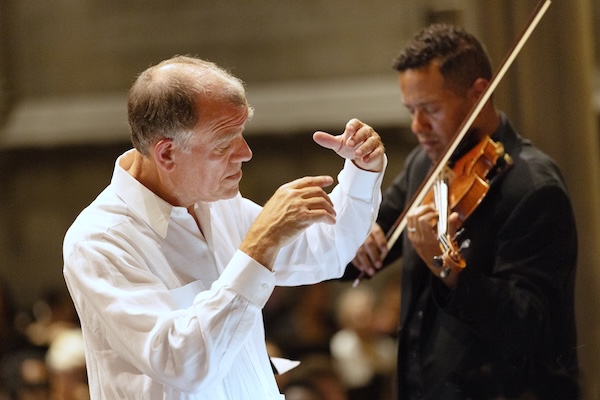
Michael Jorgensen was the violin soloist in Max Richter’s “Recomposed” with Christopher Wilkins and the Boston Landmarks Orchestra. Photo: Michael Dwyer
Autumn’s slow movement was sublime: harmonics floating in the church’s resonance, a superb cello solo underneath, a melancholy that lingered. Summer’s Adagio may have been the finest playing of the night and the audience sat rapt, barely moving when it ended. Winter’s storm found Jorgensen at his most secure, biting into the bowing with no pitch trouble at all. Winter’s quiet, unflashy ending is a strange way to close a concerto cycle, but it still elicited a standing ovation.
Gabriela Lena Frank’s “Coqueteos,” from Leyendas: An Andean Walkabout, brought the tightest ensemble work of the evening. The players were audibly connected to the music’s humor, flourishing runs, and percussive pizzicato—a fiery serenade dispatched with real polish from this year’s Pulitzer winner in music.
Julia Perry’s Prelude for Strings, arranged by Roger Zahab from a 1946 piano piece Perry originally called Lament, followed. Its blues-inflected harmonies and long, drawn phrases suited the room, though after an evening already heavy with slow music, the near-total absence of counterpoint felt one-dimensional. The ending lingered so ambiguously that it was unclear whether the piece had stopped or merely paused.
Mozart’s Symphony No. 40 closed the program, performed in memory of Kenneth Stalberg, the Landmarks Orchestra’s longtime principal violist. Given the dedication, the venue change seemed to be fate. The Molto allegro was exacting, the church’s balance problems were largely solved. The Andante brought sensitive dynamic shading, but the orchestra’s attention seemed to drift after it; the Menuetto passed without much to hold onto. The finale recovered the energy, with Wilkins at his most animated.
Landmarks Orchestra repeats the program 7:30 p.m. Friday at Bethel AME Church, Jamaica Plain, and 3 p.m. Saturday at Twelfth Baptist Church, Roxbury. landmarksorchestra.org
Posted in Performances
Leave a Comment
 Subscribe via RSS.