Dorman concerto stands out in BMOP’s ambitious final program of new works
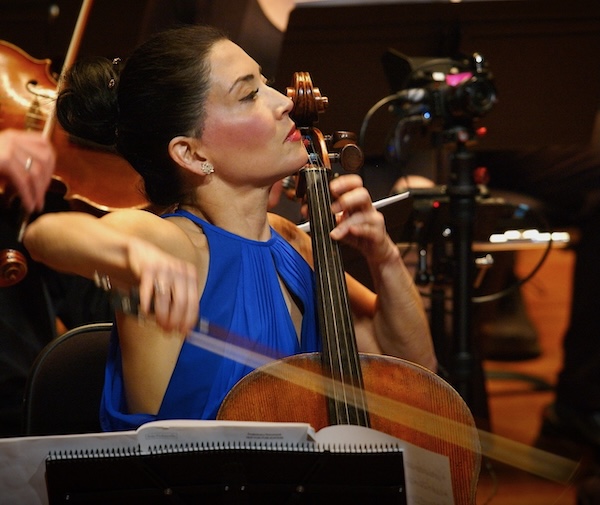
Cellist Kristina Reiko Cooper performed the world premiere of Avner Dorman’s Inner Fire with the Boston Modern Orchestra Project Sunday night at Jordan Hall. Photo: Dave Jamrog
Premieres are a gamble. A concert made up entirely of new works takes utter confidence.
Wagering on the unknown in their season finale at Jordan Hall Sunday night, Gil Rose led the Boston Modern Orchestra Project through a rare, all-premiere program with music by Paul Moravec, Avner Dorman, John Aylward, and Bernard Rogers. And the risk largely paid off.
The concert opened with the New England premiere of Paul Moravec’s Miami Variations. A Pulitzer Prize winner, Moravec wrote the piece in 2025 for the University of Miami’s centennial, and was duly premiered by the music school’s Frost Symphony Orchestra last year.
A Miami commission might lead one to expect something sun-drenched. Instead, dark and lyrical strings introduced the work as more ominous than celebratory. The piece rarely moved as a single orchestral force; a clear melodic foreground bounced between sections while the remaining forces accompanied beneath. Colors and character shifted constantly, with low brass and percussion combining at moments into something close to looming footsteps. While it makes an energetic curtain-raiser, the piece doesn’t give its melodic ideas enough space to register.
The evening’s highlight was the world premiere of Avner Dorman’s Inner Fire, a five-movement cello concerto written in 2025 for Kristina Reiko Cooper, who debuted the work Sunday night. The opening “Invocation” set the work’s governing dynamic immediately: a lamenting, modal melody over a viola drone. Flickering woodwind and brass textures, crystalline and slightly offset, created a meditative atmosphere before the music slid into “Ignition” so seamlessly the movement break was barely perceptible.
In “Wildfire,” racing cello lines drove through turbulent writing with an intensity that made one wonder how Cooper still had bow hair by the finale. Relief came in “Hearth,” the most lyrical section of the evening, with a return to the opening chant melody, here warm and cathartic, after the frenzy.
The titular final movement brought dance-like energy anchored by timpani, driving to a thunderous close, though here Cooper’s lines were occasionally swallowed by lower brass and percussion, a balance issue that obscured what could have been the concerto’s crowning moment.
Aylward’s 2025 work ambitiously titled History of the World was the program’s second world premiere. The outer movements, “Birth of David” and “Garden of Eden,” shared a language of pensive openings, thick harmonic clusters, and continuous downward scales. The textures were absorbing, though the music often seemed more focused on density than direction, and the two movements tended to blur into each other.
The middle movement, “Distant Messenger,” was the standout. Inspired by Galileo turning his gaze upward, it set oscillating horns against a starry shimmer drawing out each dissonance over a held bed of strings. Here the work’s harmonic friction felt purposeful and earned in a way the surrounding movements didn’t quite match. As a study in texture, History of the World had real moments, but it ended more abruptly than its grand framing seemed to promise.
The evening closed with a historical outlier: Bernard Rogers’ Symphony No. 5, “Africa,” written in 1959. Better remembered as a longtime Eastman teacher whose students included David Diamond and Dominick Argento, he wrote prolifically, yet his own music has largely vanished from programs. BMOP has taken up his case as part of a multi-year revival, and Rogers’ was heard in its belated New England premiere..
The compact symphony unfolds in just two movements. The first movement, “Visions,” opened with a viola solo, light and feathery, its temperate material unfolding gradually rather than all at once. A fine principal trumpet line stood out, and the movement built to a bold tutti with enough space between chords to leave the listener anticipating what came next. The second movement, “Drums (Dance),” turned more upbeat and faintly militaristic, with Rose conducting at his most impassioned. Here the percussion took over, driving the symphony to a thunderous close.
Each composer drew on the full resources of the ensemble, and BMOP met those demands with its signature assurance. Perhaps not all four wagers paid off equally, but Dorman’s Inner Fire alone justified the venture. In reviving Rogers alongside three new works, Rose made his familiar argument once more: that the unfamiliar, whether newly written or long overlooked, deserves a hearing.
Posted in Performances
Leave a Comment

 Subscribe via RSS.