Handel and Haydn Society brings vibrant life to last things with Bach and Telemann
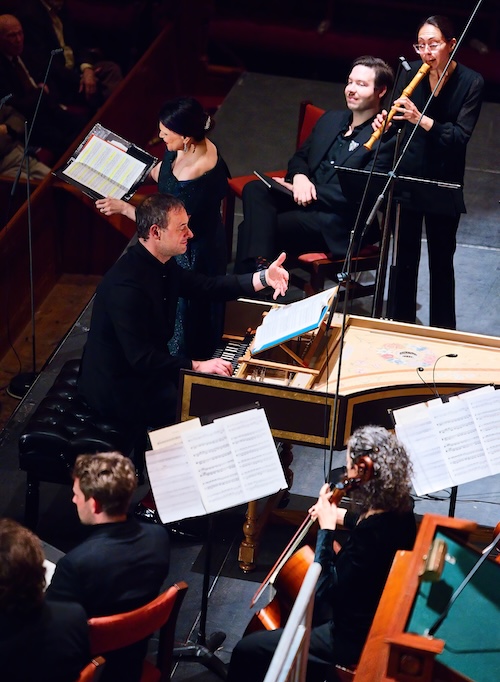
Jonathan Cohen conducted the Handel & Haydn Society Friday night at Old South Church. Photo: Hilary Scott
Typically, out-of-town tryouts start in Boston and end up in New York. But this week the Handel & Haydn Society decided to flip the script.
On Thursday, the 211-year-old group made its belated Carnegie Hall debut. The next night, they brought their program of cantatas by Telemann and Bach, plus the Brandenburg Concerto No. 6, to Old South Church, where a smallish contingent—just a dozen instrumentalists, four vocalists, and H&H artistic director Jonathan Cohen—navigated this mostly-sober lineup with style and understanding.
That was particularly true of the ensemble’s account of Bach’s Cantata No. 106. Subtitled “Gottes Zeit ist die allerbeste Zeit” (“God’s time is the best of all times”), this eight-movement meditation on mortality sets texts adapted from across the Bible, plus verses by Martin Luther and Adam Reusner. Despite its theme, the music is anything but dreary.
In fact, the opening instrumental sonata is perhaps the most beautiful thing Bach ever wrote. It certainly sounded that way Friday, thanks in part to the discreetly shaded playing of viola da gambists Anna Steinhoff and Matt Zucker.
In this cantata, Bach’s juxtaposition of ariosos and chorales are particularly striking. Soprano Robin Johannsen’s light-toned instrument in “Ja, komm, Herr Jesu” blended beautifully with the gambas and recorders, while also setting up a radiant contrast with the darker vocal fugato entries of the “Es ist der alte Bund” statements. Similarly, tenor Guy Cutting’s account of “Heute wirst du mit mir” provided a sturdy counterbalance to the haunting setting of Luther’s “Mit Fried und Freud ich fahr dahin.”
In lesser hands, the final chorale’s jauntiness can seem at odds with the work’s larger theme. But on Friday, the music’s sense of release—John Lenti’s theorbo off-beats were particularly lively—meant that the concept of spiritual freedom at the heart of Bach’s musical theology emerged vividly.
A similar result obtained in the night’s rendition of the Cantata No. 4 (“Christ lag in Todesbanden”). Though a handful of balance issues emerged between voices and instruments, the larger performance was notably well-blended and -directed.
Soprano Johannsen and countertenor Christopher Lowrey were smartly matched in tone and articulation in “Den Tod niemand zwingen kunnt.” Bass-baritone Dingle Yandell dispatched “Hier ist das rechte Osterlamm” with clean tone and a kind of stentorian sweetness.
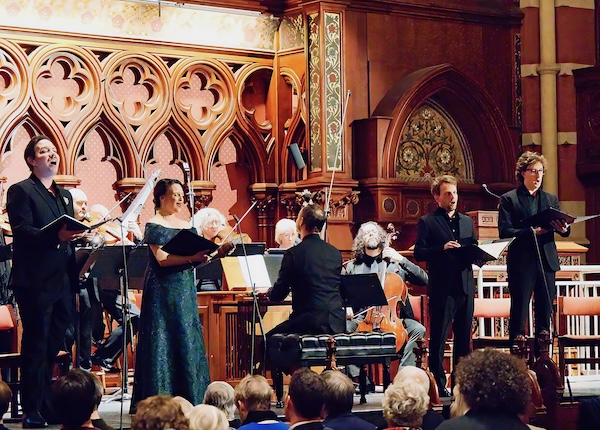
Photo: Hilary Scott
Cohen, leading the collective from a positivo, drew limber playing from the orchestra. Lenti’s contributions were, again, invitingly athletic, while violinists Aisslinn Nosky and Christina Day Martinson drew out the vigor of their parts during the “Jesus Christus, Gottes Sohn” chorale.
Telemann’s “Du aber Daniel, gehe hin” is, like “Gottes Zeit,” about last things. The Magdeburg native’s adaptation of his texts, however, is more straightforward (and less theatrical) than that of his Eisenach-born contemporary. Accordingly, the score ends up as mostly a showpiece for solo bass with a striking interlude for soprano.
Johannsen managed the last, the plaintive aria “Brecht, ihr müden Augenlieder,” with touching warmth. But the star of the evening was Yandell, whose command of the music’s character—from extroverted and pulsing to gently rocking—was total. For good measure, he also got the melismas in the recitative “Im Himmel ist der Sitz vollkommer Freuden” to snap.
The larger group brought a firm presence to the outer movements, especially the latter one. Here, Telemann’s ear for sonority and gesture carried the night: its combination of plucked strings, interwoven woodwind melodies, and sotto voce statements of the chorale “Schlaft wohl, ihr seligen Gebeine” were nothing short of hypnotic.
Before the Telemann came a billowing, delightfully conversational account of the Brandenburg Concerto No. 6. Highlighted by the playing of violists Stephen Goist and Sarah Darling, the reading was marked by a big dynamic range and excellent ensemble—the violists’ interactions with the continuo during the Adagio felt particularly locked-in.
Throughout, too, there was a palpable sense of finding joy in the process of journeying, rather than fixating on a destination. Especially given the rest of the night’s fare, that perspective was welcome.
The program will be repeated 7:30 p.m. Saturday at Sanders Theatre. handelandhaydn.org
Posted in Performances
Leave a Comment
 Subscribe via RSS.