An enjoyable and insightful Bach family affair with Sarasa Ensemble
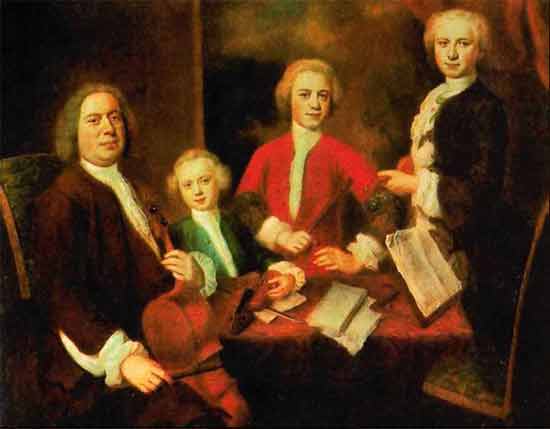
Painting by Balthasar Denner, c. 1730, of Johann Sebastian Bach and sons.
There is no such thing as fun for the whole family, Jerry Seinfeld once quipped.
But the comedian probably wasn’t taking the Bachs into account: the clan’s decades-long ethic of creative, resourceful, and inventive music-making suggests, if not necessarily domestic comity then a remarkable degree of shared, multi-generational purpose.
On Saturday night, Sarasa Ensemble celebrated some of the Bach brood in their season-closing program at the Friends Meeting House in Cambridge. The night offered music by four (and possibly five) related composers, and proved rich in variety and style.
Predictably, its most familiar items came from the pen of Johann Sebastian Bach: the Sinfonia from the Cantata BWV 156 (“Ich steh mit einem Fuß im Grabe”) and the Double Concerto for oboe and violin.
The latter fuses understated virtuosity with flowing lyricism. Sarasa’s performance, which featured oboist Daniel Bates and violinist Christina Day Martinson in the solo roles, was notable for its appealing tonal blend and enchanting sense of dance.
That last quality came out particularly well in the central Adagio, which unfolded like a triple-meter pavane. Here, Bates and Martinson managed their dialogues with touching warmth while the rest of the ensemble drew out the accompaniment’s discreet play of textures. In the outer movements, the collective’s performance was well-blended and vigorous, though some of the first Allegro’s phrasings felt a shade insistent.
Spastic phrasings are the rule, however, in much of the Sinfonia in F by Sebastian’s son, Wilhelm Friedemann. Subtitled “Dissonant” for its sudden discordant turns, the writing is marked by a saucy discursiveness and pert unpredictability worn with unabashed pride.
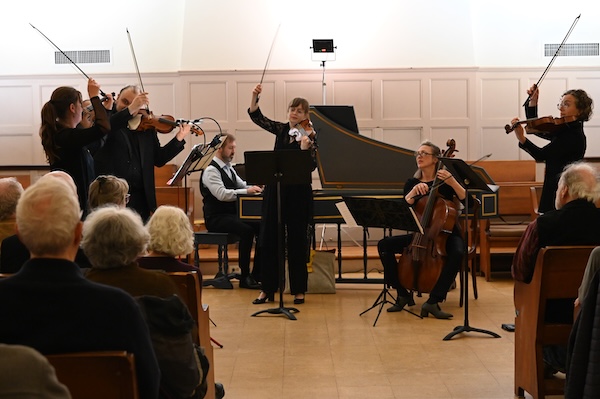
The Sarasa Ensemble performed music of the Bach family Saturday night at the Friends Meeting House in Cambridge. Photo: Chung Cheng
Saturday’s performance leaned into the score’s heaving chromatic turns with a vigor that was neatly balanced by the central part’s more settled lyricism. There, oboist Bates and Sarasa’s strings drew out the rhetoric of Friedemann’s style, the latter group turning in a haunting realization of the movement’s minor-key middle section.
If Friedemann’s writing marked an acerbic point of departure from his father’s more strictly contrapuntal voice, his younger brother, Carl Philipp Emanuel, managed to tap a vein entirely his own. Some touchy intonation aside, Sarasa dispatched the latter’s Sinfonie in B minor with taut, rhythmic concentration.
Though short, the work’s language is broadly straightforward and imitative. As such, it clearly points to the early-Classical symphony: the finale’s false endings strongly suggest the type of gesture Haydn would later master, while the Larghetto anticipates Mozart’s unaffected melodicism.
The Ouverture-Suite No. 2 of Johann Bernhard Bach proved similarly striking. A second cousin of Sebastian’s, Bernhard was an accomplished musician—he succeeded both Pachelbel and Telemann in prestigious posts—but precious few of his compositions have survived.
This Suite offers invigorating concision and striking turns of both melody and harmony. Its penultimate “Air” is a model of graceful, hymn-like songfulness, while the “Gavotte et rondeau,” “Bourée,” and “Gigue” are winningly energetic.
Sarasa’s account included a hand drum in the latter pair of movements—crisply played by cellist Jennifer Morsches—which added much to the proceedings for color and atmosphere. Those qualities applied equally to the encore of the “Bourée” from Sebastian’s Orchestral Suite No. 1, which also incorporated the drum.
The night’s other fare paid tribute to Anna Magdalena Bach, whose devotion to her family’s line of work was honored via her transcriptions of her son, Johann Christian’s, “March” and her husband’s famous C-major Prelude.
An unattributed “Aria” may, perhaps, have been an original composition of hers—or so keyboardist John McKean suggested. Either way, his performance on an enchantingly glassy clavichord was entirely absorbing: a high point in a night full of fascinating insights and stirring musicianship.
The program will be repeated 3:30 p.m. Sunday at Follen Church in Lexington. sarasamusic.org
Posted in Performances
Leave a Comment
 Subscribe via RSS.