Zander leads Boston Philharmonic in a stately yet characterful Mahler Third
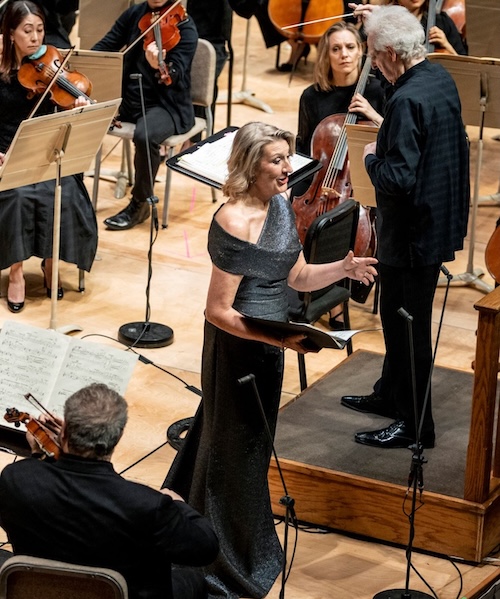
Mezzo-soprano Sarah Connolly was the soloist in Mahler’s Symphony No. 3 with Benjamin Zander conducting the Boston Philharmonic Orchestra Saturday night at Symphony Hall. Photo: Paul Mardy
“My time will come,” Gustav Mahler once predicted, “when his has passed.” So it mostly has—though the quote’s second clause, a catty anticipation of the demise of the composer’s contemporary and sometime-rival, Richard Strauss, remains unrealized.
As fate would have it, Strauss played a leading role in the 1902 premiere of his colleague’s Symphony No. 3. As head of the Allgemeiner Deutscher Musikverein, the German musician arranged for his associate’s sprawling work to be the centerpiece of that year’s festival in Krefeld—and he did what he could to ensure its success, at one point marching down the hall’s center aisle to applaud Mahler on the podium, mid-concert.
No such displays intruded on the Boston Philharmonic Orchestra’s traversal of the Third with Benjamin Zander on Saturday night. Instead, decorum reigned at Symphony Hall, at least until the finale’s double-bar unleashed a rousing, eight-minute-long ovation.
That was a perfectly justified response, given the excitement and sweep of the BPO’s performance. This was the third time the group had assayed Mahler’s six-movement, 100-minute epic (the last was in 2022) and there won’t be a fourth: the ensemble recently announced plans to shutter following the 2026-27 season.
Given that context, one might have excused some nostalgic indulgences on this final summiting of the symphonic canon’s Everest. But those sort of things aren’t the Zander way. And while this wasn’t the swiftest Mahler Third on record, the 87-year-old maestro’s take remained full of purpose and frequently bristled with character.
Across the night, textures were clear, rhythms crisp. As a result, the first movement’s unwieldy structure made for some exciting drama. In it, the Philharmonic’s mix of tight ensemble, full-bodied tone, and pointed solos—principal trombone Gregory Spiridopolous was one of the evening’s several stars—brought a touch of order to the introduction’s several digressive turns and ensured that the larger section cohered.
For its part, the Menuetto was a picture of gracefulness and charm, not to mention invention. Zander, by paying close heed to the relationships between tempo, meter, and character in each of the movement’s several sections, illuminated the novelty of Mahler’s style and ear for sonority with captivating verve.
Nor was there any shortage of spirit to be had in the quietly rollicking passagework at the beginning of the Scherzo, which was dispatched with droll precision. Though its climax came out a shade deliberately, the framing posthorn solos were outstanding and delicate.
For the symphony’s vocal movements, Saturday’s performance featured Dame Sarah Connolly. The British mezzo-soprano has delivered some fine Mahler performances with the BPO in recent years and her burnished, direct account of the composer’s plaintive setting of Nietzsche’s “O, Mensch! Gib Acht” was no exception. The singer’s accompaniments from Zander and the orchestra were rich and devotional, featuring conspicuously fine playing from principal oboe Nancy Dimmock, English hornist Alessandro Cirafici, and principal horn Kevin Owen.
Connolly’s contributions in the subsequent “Es sungen drei Engel” were likewise bracing. There, too, the women of Chorus pro Musica and the Radcliffe Choral Society formed an appealingly light-footed coterie of heavenly hosts, while The Choristers of Saint Paul’s Choir School intoned their chiming part with vigor.
In recent years, Zander has developed a fascination with the concept of “tempo rubato,” where one of the key principles of chamber music—namely flexibly stretching phrases and lines—is applied to larger forces. The approach was in evidence on Saturday and occasionally threatened to get in the way of the music: parts of the first movement, like the buildup to its storm episode, were a touch stately.
But in the finale, where one felt the tempos drawn out a bit more than usual, the section’s phrasings were, paradoxically, absorbing. Indeed, the BPO’s playing was so responsive and locked-in that the reading took on an all-enveloping, in-the-moment quality. This, and the performance’s beguiling lucidity, brought the night to a near-transcendent close, the Adagio’s counterpoint of melody, harmony, and lustrous tone orbiting one another with utter naturalness, purpose, and beauty.
The Boston Philharmonic Youth Orchestra plays music by Harbison, Gershwin, and Copland 7 p.m. May 3 at Symphony Hall. bostonphil.org
Posted in Performances
Leave a Comment
 Subscribe via RSS.