Salonen returns to BSO with clarifying Bruckner and his delightful Horn Concerto
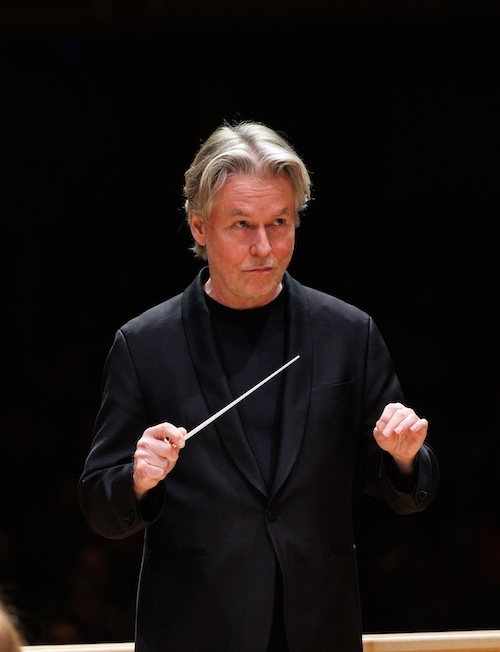
Esa-Pekka Salonen conducted the Boston Symphony Orchestra in the American premiere of his Horn Concerto and Bruckner’s Symphony No. 4 Thursday night. Photo: Robert Torres
Sometimes a change of pace can be a healthy thing.
Take the Boston Symphony Orchestra’s approach to the first two months of 2026: each of the ensemble’s subscription concerts through the end of February have featured (or are slated to include) an ensemble, local, or national premiere. Now at the six-week mark, the undertaking has resulted in some insightful programming and conspicuously invigorating playing.
The trend continued on Thursday with Esa-Pekka Salonen making his first return to Symphony Hall since April 2012. Just like on that previous visit, the Finnish composer-conductor brought along a new work of his own to show off, in this instance his Horn Concerto, a BSO co-commission.
Premiered last year in Lucerne, the nearly 30-minute effort is something of a love letter to the horn and the orchestra. Allusions to the solo and symphonic canon abound: Mozart, Wagner, Scriabin, and Bruckner, for certain—perhaps Schumann, Strauss, and others, as well. Though Salonen’s writing can be harmonically and expressively elusive, the concerto brims with counterpoint and color. Its finale, in particular, has the chill, dancing vibe of a Southern California beach party.
This American premiere featured its dedicatee, Stefan Dohr, as soloist. A new-music champion and virtuoso par excellence (among other things, Dohr is the principal horn of the Berliner Philharmoniker), he proved a particularly collegial partner, drawing an array of colors from his instrument while also paying close attention to the concerto’s many subtle doublings with members of the orchestra.
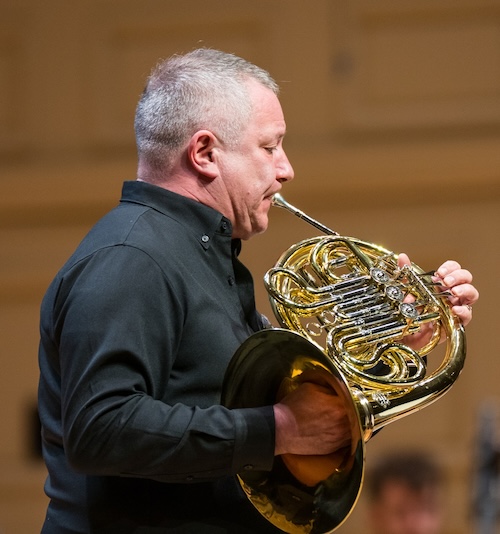
Stefan Dohr was tech soloist in the American premiere of Salonen;s Horn Concerto with the BSO Thursday night. Photo; Robert Torres
Those latter moments were prismatic and sometimes—like the ruminative turn near the end of the first movement—unexpectedly touching. More extroverted conversational spots were dispatched with aplomb and Dohr easily navigated his part’s many runs and handful of extended techniques: his singing through the horn while playing it occasioned more delighted smiles around Thursday’s audience than is the norm for a premiere.
Salonen drew playing from the BSO that was notable for its rhythmic security and depth of sonority. The first movement’s opening gesture of microtonally tuned strings cushioning Dohr’s natural horn was terrifically eerie, like something out of Alexander Nevsky. Similarly, the slow central section was smartly balanced and, in the last part, the orchestra leaned into the music’s stylistic flexibility with palpable vigor.
While such a complex score requires more than one hearing to grasp its full measure, Salonen seems to have crafted a work that, despite its challenges and headiness, is vivid and—in the best sense—accessible. As a friend noted at intermission, Boston can use more music like this.
Boston can also use more Bruckner like the account of that composer’s Fourth Symphony Salonen led after the break. First heard in Vienna in 1881, this so-called “Romantic” Symphony is perhaps the best-known of the Ansfelden-native’s nine installments in the genre.
Thursday’s interpretation was impeccably well-directed and balanced, from the first movement’s shimmering “daybreak” scenario to the expertly realized, slow-burning buildup of tension and release in the finale’s coda. Throughout, purity of tone and texture were the rule. Balances were ever lucid, with even the grandest, most heaven-storming episodes involving playing of remarkable sonic definition.
At the same time, Salonen’s reading was one of real character. The first movement’s second subject danced with a beguiling lilt. So, surprisingly, did the Andante quasi Allegretto’s processional. Here, much to the music’s benefit, the conductor underlined the latter part of that tempo indication: the tone may have been devotional and the viola section’s solos glowingly warm, but this was no stodgily dogmatic cortege.
Nor was there any sense of Bruckner the pedant on offer. Instead, Thursday’s account underlined the sheer originality of this music. The jump cut-like transitions in the finale were jarring in the right ways and parts of the Scherzo called to mind the image of Berlioz at a Styrian country fair.
If not the last word in spiritual transcendence, Salonen’s approach had the effect of demolishing the caricature of Bruckner as some forbidding, esoteric Austrian mystic. Instead, he emerged as a true symphonic visionary—and, especially with the latent cinematic aspect of his style on such vivid display, a composer for our times.
The audience seemed to agree, applauding after the first two movements and, in the process, shattering the delicately wrought mood Salonen and the BSO had crafted over the Andante’s closing bars. (Oddly, the house then sat on their collective hands at the conclusion of the swaggering Scherzo.)
Perhaps they’d been encouraged by the night’s opener, Luciano Berio’s riotous arrangement of Luigi Boccherini’s Ritirata notturna di Madrid. A depiction of night revelers roaming the streets of the Spanish capital, Boccherini’s original exists in four transcriptions. Berio superimposed the tetrad to create a multidimensional collage that exults in the tonal discrepancies between the various editions.
Thursday’s rendition embraced the latter but not at the expense of the exuberance of the larger whole. Indeed, this was night music of commanding shape, color, wit, and good cheer.
The program will be repeated 1:30 p.m. Friday and 8 p.m. Saturday at Symphony Hall. bso.org
Posted in Performances
3 Responses to “Salonen returns to BSO with clarifying Bruckner and his delightful Horn Concerto”
Leave a Comment
 Subscribe via RSS.
Posted Feb 13, 2026 at 3:33 pm by Zev B.
I agree with every comment on the musical achievements of the evening. The whole orchestra, the brass especially, was in top form.
However, the audience last night was appalling. Coughing fits in all of the quietest moments, frequent misplaced applause, dropped belongings, and several phone notifications and someone’s navigation going off in the Bruckner all detracted from what should have been the best performance of the year.
I hope Friday and Saturday performances are better respected.
Posted Feb 14, 2026 at 9:19 am by Matthew P
I agree with Zev,
The audience on Thursday was among the most distracting ones in recent memory for me. I would welcome an informational guide (very kindly worded) on attendee etiquette printed on every program. If the music truly moves you and you wish to clap, great! Didn’t seem like that was the case on Thursday unfortunately, just people who didn’t know when to hold applause. I don’t fault people for not knowing, however. I just wish folks silenced their phones and held on to their belongings.
That being said, the BSO at Salonen’s command was impeccable. I wish I could see it again.
Posted Feb 14, 2026 at 4:32 pm by John Shriver
The audience at the Friday afternoon performance was well-behaved, as is typical with us old folks. One cell phone, and it wasn’t very loud — but close to me. But sad that the house wasn’t full, maybe 80%?
I was totally delighted with the Bruckner, consistent momentum from beginning to end, and much use of dynamics. Some of the climaxes in the fourth movement were thrilling. Yet the final build was not that loud, but it had a wonderful tension that popped with the resolving key change a few bars from the end.
There were some slightly inelegant brass entries, but trivial compared to the clams we had to endure in the 1990’s.
The horn concerto was a solid work, not show-off modern. Thanks to the composer!