Handel and Haydn Society takes the path less chosen with Christmas program
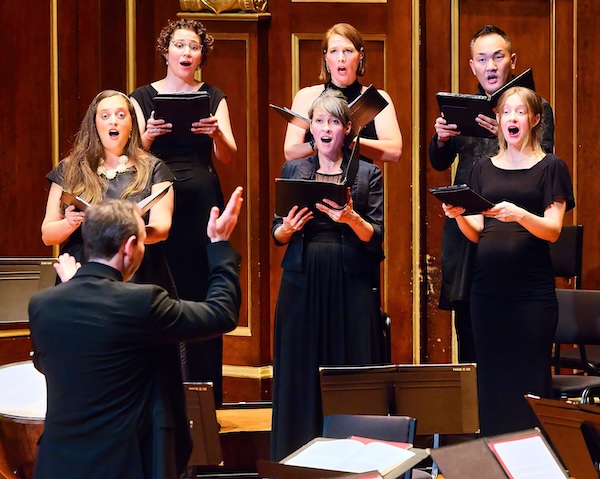
Scott Allen Jarret conducts member of the Handel and Haydn Chorus in a Christmas Baroque program Thursday night at Jordan Hall. Photo: Hilary Scott
“Well, Franklin,” Theodore Roosevelt quipped to his cousin after the younger man married the president’s niece, Eleanor, “there’s nothing like keeping the name in the family.”
A comparable sentiment obtained—at least up to a point—on Thursday night for the Handel and Haydn Society’s annual Baroque Christmas concert at Jordan Hall. Led by Scott Allen Jarrett, the event paired music by the most popular Bach, Johann Sebastian, with his obscure cousin, Johann Ludwig, plus a Magnificat by the even more neglected Christoph Graupner (who studied in Leipzig with Sebastian’s predecessor at the Thomaskirche, Johann Kuhnau).
As it happened, the evening uncovered even more tantalizing connections: Graupner was offered his mentor’s post after Kuhnau’s death in 1722. He turned it down and the cantor-ship at St. Thomas’s went, eventually, to Bach.
Had Graupner made a different choice, the history of Western music may or may not have been altered. But, on the merits of this Magnificat, Leipzigers—who came to make a habit of grumbling about the length and complexity of Bach’s sacred output—would at least have been well-satisfied. The score, which was first heard a few weeks before Graupner officially auditioned in Leipzig, is admirably direct, musically and expressively.
Though the outer sections put something of a militant spin on the Marian text (“My soul doth magnify the Lord”), there’s vigor, majesty, and jubilance to be had in all the right spots. Plaintive introspection, too: the “Quia respexit” and “Et misercordia” involve some affecting vocal and instrumental writing.
And Graupner was no slouch as a technician or dramatist. His counterpoint in the concluding “Gloria Patri” is invigorating and extended call-and-response figures between soloists and chorus prove to be bracing attention-getters over the Magnificat’s opening pages.
If anything, the score’s tendency towards brevity—the “Fecit potentiam” movement is on-and-gone in the blink of an eye—suggests efficiency rather than inspiration. But even taking that into consideration, there’s much to admire about the music’s fresh, celebratory tone and engaging tunefulness.
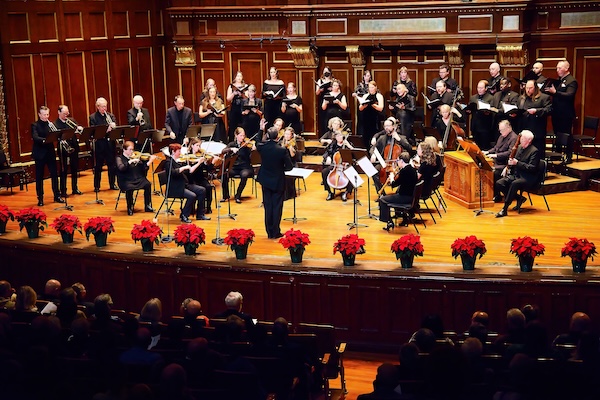
Photo: Hilary Scott
Thursday’s performance didn’t stint on brio or style. The H+H Chorus sang with a rounded, unified sonority; textures were consistently lucid, and the group’s rhythmic energy was picture-perfect—delightfully so in the chugging melismas during the “Ex exultavit” section.
Soloists, all drawn from the choir’s ranks, delivered their parts with character and precision. Highlights included Sonja DuToit Tengblad’s pure “Et misercordia” and Sarah Vitale’s luminous turns in “Quia respexit.”
Jarrett presided over the reading with a sure hand and a clear sense of where each phrase was headed. Indeed, there was a lilt to Thursday’s Magnificat that was ingratiating, the orchestra seeming especially attuned to the music’s nuances, be they brash, peppy, or lyrical. Principal oboist Debra Nagy’s solos sang with conspicuous warmth.
Johann Ludwig Bach’s Uns ist ein Kind geboren benefited from a similar attention to detail. Setting the same text from the Book of Isaiah that Handel later adapted for Messiah (“For unto us a child is born”), Bach crafted a competent, idiomatic motet for double chorus whose chief musical appeal lies in the lively little fugue with which it ends.
Accordingly, the joys of Thursday’s traversal lay chiefly in the ensemble’s execution of the score, which was excellent. The chorus sang with biting energy and superb diction. Principal cellist Guy Fishman, principal bass Heather Miller Lardin, and organist Ian Watson comprised the night’s highly satisfactory continuo. The collective’s overarching account was lean but never scrawny and the final chord a model of flawlessly blended resonance.
If Thursday’s Graupner and J. L. Bach items were characteristic of their creators, so were the evening’s J. S. Bach selections.
His Sanctus (BWV 237) included some surprising, subtle harmonic twists in its euphoric, two-minute runtime. And the cantata Christen, ätztet diesen Tag gave at least a little credence to contemporaneous complaints about the composer’s verbosity.
Nevertheless, the latter’s solo sections were all firmly sung. Of particular note was the duo aria, “Gott, du hast es wohl gefüget,” in which soprano Logan Trotter’s light, airy instrument and bass Craig Juricka’s rich, weighty one complemented each other admirably.
The H+H Chorus, though relegated to just the two outer movements, managed their appearances with typical aplomb. Jarrett ensured that everything moved as it should and the orchestra’s contributions were, by turns, limber, urgent, and noble.
To begin the night, the H+H Youth Choruses Concert Choir presented a further pair of holiday numbers: Vivaldi’s evergreen Gloria and Victor C. Johnson’s arrangement of the South African carol “Sizalewe Indodana.” Though it proved tricky to square the stylistic circle with the latter and the rest of the night’s offerings (among other things, “Sizalewe” involves hand clapping and a cowbell), the group sang with radiant good cheer.
The program will be repeated 3 p.m. Sunday at Jordan Hall. handelandhaydn.org
Posted in Performances
Leave a Comment
 Subscribe via RSS.