Zander, Deljavan, and Boston Philharmonic deliver a masterful afternoon of Brahms
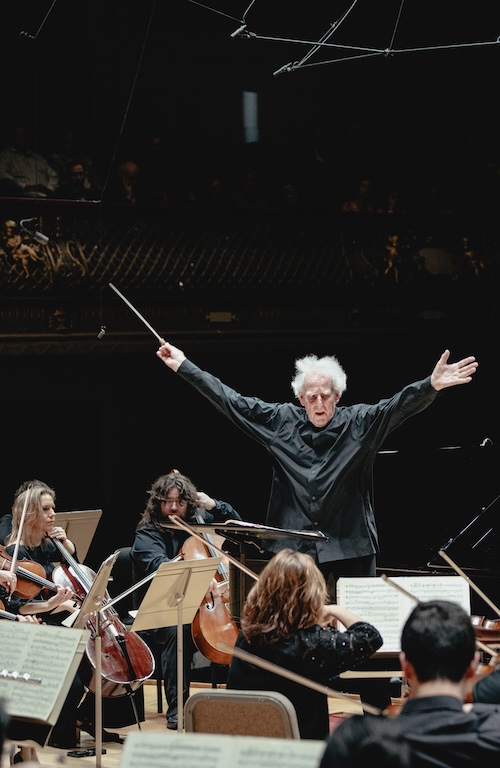
Benjamin Zander conducted the Boston Philharmonic Orchestra in Brahms’ Symphony No. 1 Sunday afternoon at Symphony Hall. Photo: Paul Mardy
Distinguishing oneself in the long lineage of classical music is no small feat, and one could argue that Johannes Brahms’s deepest internal turmoil was from this very challenge. On Sunday afternoon in Symphony Hall, Benjamin Zander and the Boston Philharmonic Orchestra approached these struggles with genuine devotion to Brahms’s craft in Piano Concerto No. 1 and Symphony No. 1. What an intriguing pairing this is – ostensibly the “firsts” in two genres but separated by decades of experience in composition and in life.
Pianist Alessandro Deljavan, a frequent BPO collaborator, brought both technical command and intense introspection to the Concerto No. 1 in D minor. That key is more often associated with a composer’s late works, such as Mozart’s Requiem or Beethoven’s Ninth, yet this concerto provided instead a dark, deeply troubled angst of a young composer. Zander and the orchestra opened with searing intensity: the first theme rumbled like a storm, and the strings balanced that weight with floating wails.
Deljavan entered with a hefty, powerful sound that set the tone immediately, his phrasing carefully attuned to Brahms’s harmonic shifts. He is a pianist of contrasts: his heavyweight sonority strengthens his delivery, yet his light arpeggios sparkle and his subtle Romantic-era rubato sings. An earlier intense octave passage jumbled, but his curiously low-lying technique for fortissimo passages and trills achieved impressive clarity. The orchestra, whether through the composer’s nascent orchestral writing or interpretive disjunction, sometimes lagged, unable to fully match the pianist’s flexibility with time and color in this movement.

Alessandro Deljavan was the soloist in Brahms Piano Concerto No. 1 with Zander and the Boston Philharmonic. Photo: Paul Mardy
The Adagio unfolded with lieder-like sensitivity. Deljavan’s shaping was lyrical and poised, while the orchestra’s legato lines, especially in the woodwinds, painted a soft palette of blended voices. Yet the pianist’s habit of slightly spreading open chords just enough to blur their attack proved a mixed effect. The voicing and line may have spoken even more eloquently without it.
In the Rondo finale, Deljavan propelled the music forward with epic conviction. Each episode connected convincingly to the overarching narrative, and the pianist handled Brahms’s intricate passagework with thrilling ease. The orchestra, too, seemed swept up in this intense energy. The cadenza in the midst of these rock-and-roll sequences was breathtaking and commanded a standstill in the hall.
Even after this exhausting concerto, Deljavan presented two encores: a surprisingly lyrical reading of Scriabin’s Prelude from his Two Pieces for the Left Hand and an eccentric yet entertaining account of Chopin’s A Minor Mazurka, Op. 7, no. 2.
Brahms was riddled with perfectionist tendencies, scratching out and reworking continuously, and his First Symphony notoriously took decades of his compositional productivity. The resulting symphony is a monumental, massive work played in orchestras around the world in all sorts of interpretations and calibers.
Zander, often known for unorthodox but historically informed musical choices in tempi, took a more mainstream approach here. His bigger focus, then, seemed to be in the inner details, and this decision proved effective with this piece and this hall.
With an expanded orchestra filling the stage, the BPO produced a rich, enveloping sound from the first bars. The opening’s dark hues and warm strings generated that spine-tingling tension one only feels live: the sound expanding until it seemed to reach every corner of the hall. Zander’s pacing balanced architectural control with expressive warmth, revealing the sophistication of Brahms’s fully matured orchestral voice.
In the Andante sostenuto, the mezza di voce swells in the strings integrated so naturally that they almost made one forget the wind solos. The concertmaster’s warm tone in his solo blended astonishingly well with the sotto voce horn line, in a marriage of timbres that felt quintessentially Brahmsian. The third movement was sweet with Zander’s attention to Brahms’s characteristic metric shifts between duples and triples giving it buoyant life.
The epic finale demonstrated the BPO’s full power at musical narrative. The Adagio pizzicato section was meticulously coordinated, and the trombone choir before the chorale was beautifully balanced and precisely timed. Zander’s tempo for the triumphant main theme was slightly slower than expected, but it lent the moment a radiant solemnity. The horn solo burst forth with luminous resonance, almost too vivid on its first entrance, but each recurrence recalled that first glow with moving nostalgia. Small details throughout—articulation, phrasing, inner balance—stood out as evidence of Zander’s precision and preparation. The finale slows to its climactic four punctuated thumps, but then the orchestra released this tension in a blaze of exultant sound.
It is a curious thing that Symphony Hall was abysmally empty for such a complete, fulfilling performance of these well-loved works. The attention and dedication on display spearheaded one of the most Brahmsian interpretations of these pieces this city has seen in years. For those fortunate enough to witness it live, it was an unforgettable reminder of Brahms’s depth, Deljavan’s boldness, and Zander’s undiminished capacity to shape music with insight and empathy.
The Boston Philharmonic Orchestra presents Verdi’s Requiem 3 p.m. November 23 in Symphony Hall. bostonphil.org
Posted in Performances
Leave a Comment
 Subscribe via RSS.