Goerne and Trifonov redefine Romanticism within Schubert’s late works
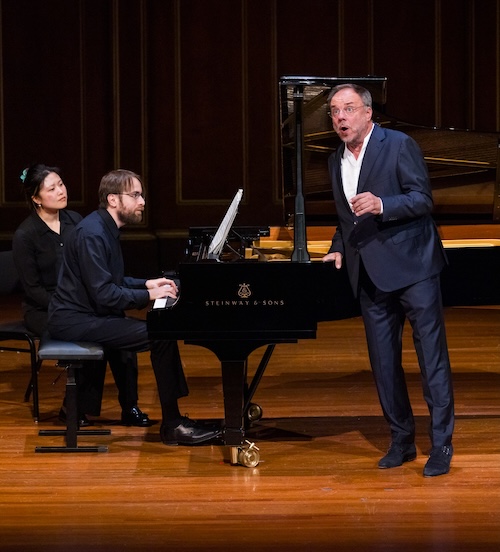
Baritone Matthias Goerne and pianist Daniil Trifonov performed music of Schubert Friday night at Jordan Hall for the Celebrity Series. Photos Robert Torres
What allows great classical musicians to endure is not merely fidelity to tradition, but their ability to reveal something personal and unique within these historical pieces. Baritone Matthias Goerne and pianist Daniil Trifonov, both highly respected performers in their own right, combined their distinctive approaches to Schubert’s music in a Celebrity Series recital Friday night at Jordan Hall.
Trifonov opened the evening with Schubert’s Piano Sonata in G major, D. 894, a work whose introspective intimacy conceals structural detail. His performance was equal parts mercurial and meticulous, shaped by a physical expressivity that seemed to conduct every phrase through his body. One could almost see his breath and movement fuse with the sound, a kind of embodied phrasing that hinted at his natural empathy as a collaborator.
The first movement, expansive and hymn-like, emerged with almost Beethovenian seriousness. Trifonov treated fortes with near-orchestral weight—sometimes to excess—but the recapitulation, with its floating treble lines, twinkled above toward the glass ceiling of Jordan Hall. His storytelling felt intensely personal, as if one could eavesdrop on an inner monologue. At times, though, one wanted bit more space between larger-scale ideas for Schubert’s architecture to breathe.
In the Andante, Trifonov revealed his flair for coloristic contrast, every theme seemingly painted in a different hue. The Menuetto brought the most rhythmic vitality of the four movements. Its dance-like pulse carried a natural swing, though Trifonov’s pedal clearing before the downbeat sometimes disrupted the sense of continuity. The trio section was a warmly voiced oasis while his repeated chords in the outer sections were brashly emphatic, more orchestral than pianistic.
Trifonov closed with a finale of gleaming energy with Schubert’s humor and vitality shining through consistently in each repetition of the theme.
After intermission came a substantial traversal of Schwanengesang, D. 957, though not as published by Tobias Haslinger. Goerne and Trifonov inserted Schubert’s late song “Herbst,” D. 945, in the midst of the Ludwig Rellstab poems, following with Heinrich Heine poems and omitting the one Johann Gabriel Seidl poem that closes the original collection. Goerne has done his unconventional edition before, and it served to underscore the duo’s strong personalities. It’s no wonder the two men have collaborated multiple times throughout the years—their chemistry was compelling, and their phrasing meticulously aligned with a shared aesthetic and understanding of rubato.
The tone of the text surely touts ideals from the Romantic movement, such as the strong involvement of nature, appreciation for beauty, and the role of one’s emotions and passions. Goerne and Trifonov capitalized on these ideas within Schubert’s music, bringing form-breaking harmonies and sections to the forefront, taking both colors and rubato freely, and starkly differentiating contrasting sections.
A gently restrained opening “Liebesbotschaft” segued into the foreboding “Kriegers Ahnung.” Here, the piano’s ominous opening chords paved the way to Goerne’s smoky concentration in the low register and supple text inflection. The performance traced and delineated light and dark with masterful subtlety. In “Frühlingssehnsucht,” shared melodic lines bloomed with real intimacy, each “Wohin?” and “Hinab” phrase shaped like inner sighs.
Some of Goerne’s physical stage gestures were more effective in this performance than others. In “Ständchen,” his turning toward the piano and the floor muffled both diction and projection, robbing the song of clarity.The interpolated “Herbst” itself, inserted between two darker songs of the collection and taken at a slow pace, accentuated the surrounding gloom.
Still, their interpretive insights often outweighed such quirks. “In der Ferne” captured the poem’s restless unease, where the piano echoed his phrases with uncanny precision. In “Abschied” Trifonov’s rhythmic rigor matched Goerne’s crisp German diction beautifully.
Many of the highlights of this performance appeared in Heine’s part of the collection. “Ihr bild,” text set by numerous other composers, notably Clara Schumann and Hugo Wolf, is an intimate, bare-bones approach under Schubert’s hand. The unison lines were perfectly together, satisfying in the tricky task of doubling. Goerne bravely sacrificed pure tone for raw storytelling, and the gentle “wunderbar” shimmered with fragile awe.
“Das Fischermädchen” lilted in lovely phrases, Goerne’s performance displaying a beautiful Schubertian simplicity, exemplifying his melodic gifts while adorned with natural inflections.
Trifonov’s signature pedal lent “Die Stadt” an almost French impressionistic blur, the harbor scene materializing through haze. “Der Doppelgänger” was chilling in its restraint. Goerne’s upper register, once withheld, blazed through in the open vowels in the line “Der Mond zeigt mir meine eigne Gestalt.” Here again were the compelling contrasts: the first stanza tapered like a dying aria while the final stanza resonated in the mask to create a gnarly sound befitting the rebuking character. Trifonov stretched the final chords into an almost unbearable stillness and tension.
For an encore, the pair offered “Die Taubenpost,” the song they omitted from the published Schwanengesang. The choice was fitting after so much darkness: this messenger dove arrived not as innocence restored, but in a steady, authoritative tone of peace. Phrases still managed to float outward and flap their wings, a last breath of grace after the night’s emotional turbulence.
Together, Goerne and Trifonov reminded the audience that Schubert’s world is one of contradictions—light and dark, serenity and anguish. Their recital, full of idiosyncrasies and insight alike, revealed two artists unafraid to risk imperfection in pursuit of inner passion and truth.
The Celebrity Series of Boston presents the Viano Quartet performing works by Haydn, Mendelssohn, Webern, and Shostakovich 3 p.m. November 2 at Groton Hill Music’s Meadow Hall. celebrityseries.org
Posted in Performances
Leave a Comment
 Subscribe via RSS.