Seraphim Singers reflect on last things with a nicely varied program
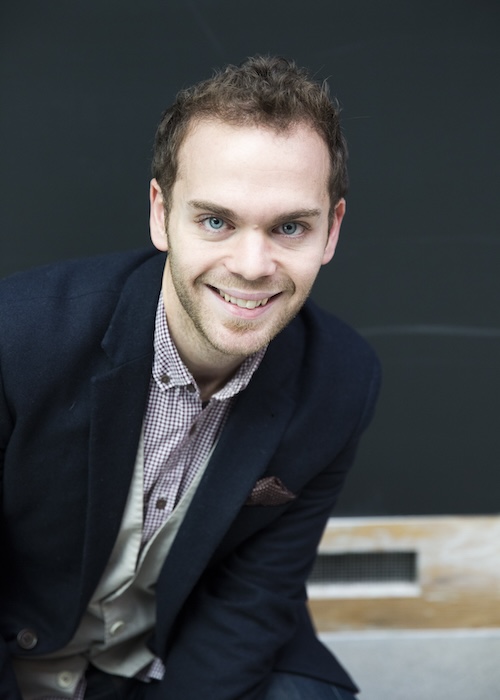
Eric Christopher Perry conducted the Seraphim Singers Saturday night at Holy Name Parish.
“Everyone should remember,” an anonymous text under the 15th-century Totentanz frieze in Lübeck’s Marienkirche once warned, “that nobody can live forever.” Neither do buildings or artworks: the poem fulfilled its own injunction when it was incinerated (along with the images it accompanied) during an air raid in March 1942.
Uncomfortable as the prospect of mortality appears, it can make for good drama and thoughtful programs, as was the case with Saturday night’s offering from the Seraphim Singers at Holy Name Parish. Styled as “Danse macabre,” the event fused poetry, plainchant, Renaissance music, and selections by two distinctive 20th-century composers—Lili Boulanger and Maurice Duruflé—into a 75-minute-long reflection on the thin line between life and death.
The night’s big item was the latter’s Requiem, heard in its 1948 version for organ, choir, and soloists. Originally commissioned as an orchestral tone poem by the Vichy regime, Duruflé’s score followed the model of Fauré in utilizing a bowdlerized version of the Roman rite that skips out on most of the excitement of the Dies irae sequence.
What’s more, he opted to base his setting on medieval melodies embossed within an impressionistic harmonic framework. The results are fitfully vigorous but more often lush and consoling; one of the Requiem’s interpretive challenges lies in drawing textural and tonal variety from multiple movements that can easily sound too similar.
Saturday’s traversal, which was led by the Singers’ interim music director Eric Christopher Perry, didn’t always manage that. Instead, it took some time to acclimate itself to the space and Heinrich Christensen’s organ accompaniments. Balances of the non-full-bodied type in the “Introit” and the “Domine Jesu Christe” sections tended towards texturally hesitancy and moments of spotty intonation dotted the evening.
All the same, the “Kyrie” was shapely and the “Agnus Dei’s” counterpoint rhythmically pert. In the “Libera me,” the men of the chorus navigated the music’s chromaticism with surety while the sopranos brought gentle purity to the opening part of the “In Paradisum.”
The night’s soloists both fared well. Mezzo-soprano Julia Soojin Cavallaro’s account of the “Pie Jesu” filled the cavernous sanctuary with seeming ease and baritone Will Prapestis imbued his solos with golden intensity. If the larger performance didn’t quite capture the evening’s discreet dancing theme, that perhaps owed more to Duruflé than not—though parts of the “Introit” betrayed a charming lilt.
Regardless, there was no shortage of rhythmic direction to be heard in the group’s well-blended rendition of Orlande de Lassus’ La nuicte froide et sombre or in Perry’s lucid solo take on the Occitan folk song “Lo Boièr.” The Singers’ diction and intonation, however, lacked a certain measure of confidence in Boulanger’s woozy “Pie Jesu.”
Not so their interpretation of Pierre Abélard’s Jacob super filios suos. A setting of the biblical patriarch Jacob’s lament for his son, Joseph, this near-1,000-year-old music, heard in a performance edition specifically created for the Singers by Jayson Keeton, lent the night its most striking moments of drama, both textual and musical.
With soloists singing from the center of the main floor, choral responses emanating from the organ loft, and Paul Mattal’s droning cello obligato holding everything together, it could hardly have been otherwise. Even so, there was something especially visceral and moving about this rumination on a specific loss that nothing else in the evening quite equaled.
That included the readings, between various numbers, of about half of Charles Baudelaire’s poem Danse macabre and, to start off the night, organist Christensen’s delivery of Edwin Lemare’s arrangement of Camille Saint-Saëns’ eponymous song/tone poem.
Clean textured but somewhat deliberate, that score’s presence on this otherwise sober concert ended up being a bit jarring—not least because its climaxes sounded like demonic carousel music. Nevertheless, the Saint-Saëns provided the evening welcome jolts of whimsy and vim.
The program will be repeated 3 p.m. Sunday at First Church in Cambridge. seraphimsingers.org
Posted in Performances
Leave a Comment
 Subscribe via RSS.